Build the intelligence your operation actually needs.
Custom AI systems is Naevum's build path for leaders whose work no rented tool fits, so that their folders, memory and model use become one stack they own.
Illustrative first engagement: a procurement lead needs to explain changed supplier commitments using a bounded set of approved policy and supplier documents.
Bound the sources and responsibility
The procurement lead selects the documents, the recurring question and the decision that remains theirs. Record access rights, excluded material, freshness and the deployment boundary.
Starts with
An approved policy set, supplier revisions and a recurring planning question.
Produces
A source/rights map and an agreed evaluation question set.
Follow one changed commitment
A supplier revises a delivery date. The working slice recovers the earlier answer from the earlier evidence and proposes a current planning update from the revised source.
Produces
An explainable answer with source and validity, plus a proposed next step.
Condition
The procurement lead retains the procurement decision.
Deliver and examine the slice
Deliver the bounded application, deployment/recovery instructions and acceptance evidence. Test historical answers, excluded-source refusal, correction propagation and the agreed interrupted-work case.
Produces
A useful scoped system and a documented decision about the next increment.
Condition
This is an engagement design, not a universal integrated installation claim.
A world model you can inspect.
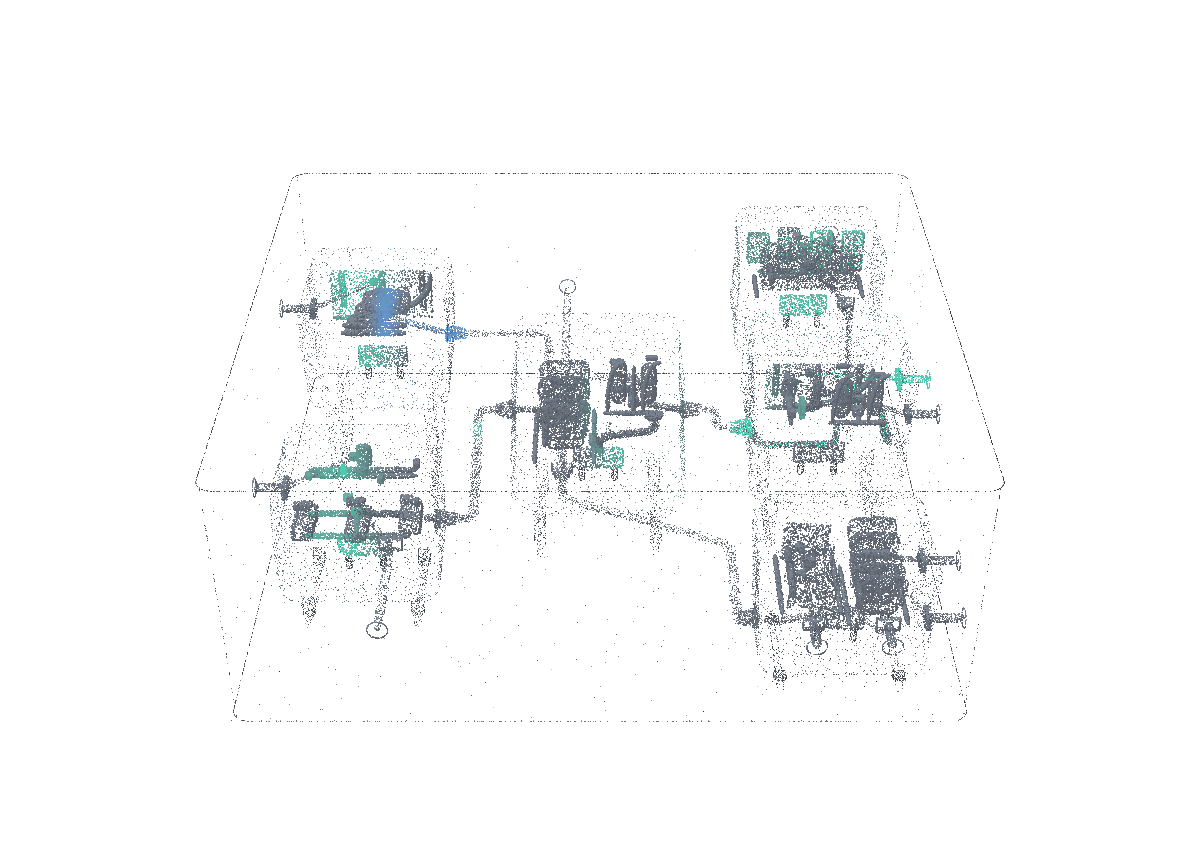
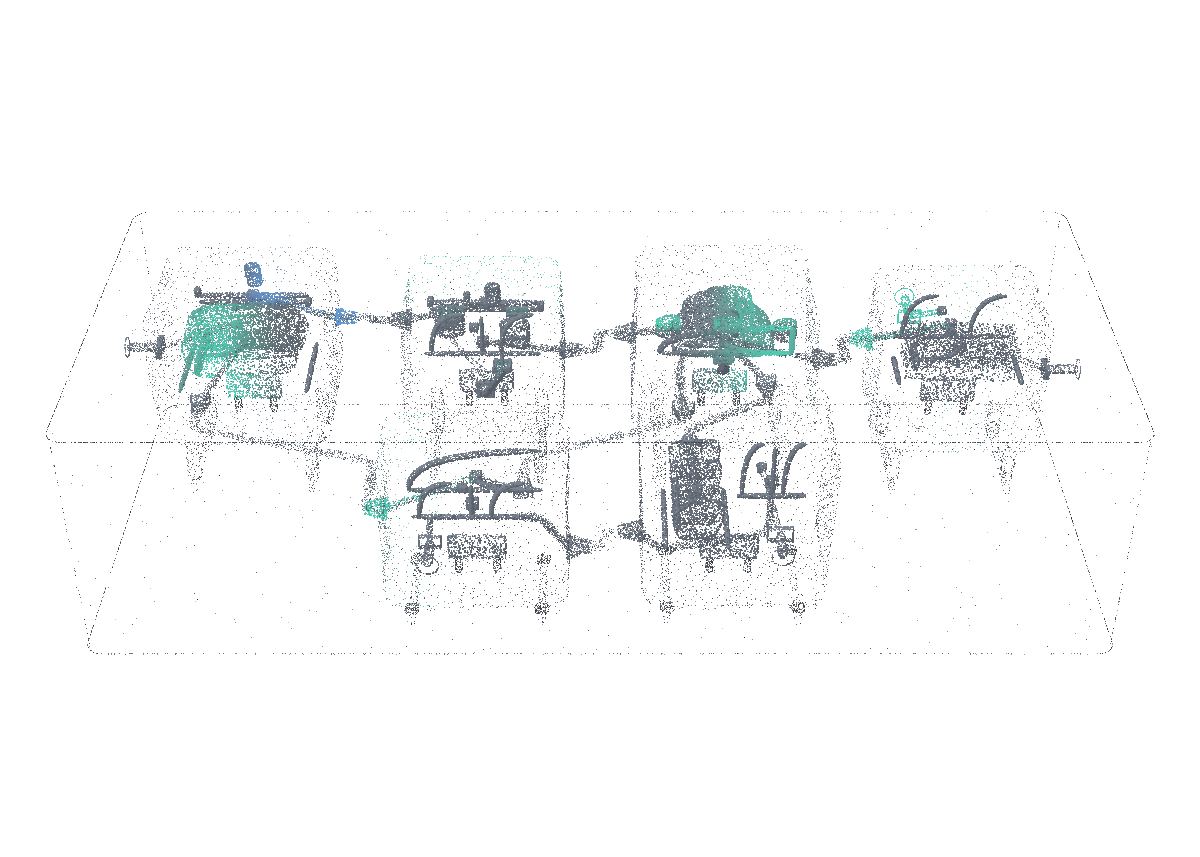
Connected sources become structured context. Observations keep their origin; inferences remain open to correction. This is the architecture of a dedicated engagement, shaped around the world you choose to connect.
Loading model
Attributed record store
Preserve source-connected history with two distinct time axes.
Inputs
Original or changed policy with source and both time axes.
Transformation
Preserve source-connected history with two distinct time axes.
Retained state and outputs
Source, holder, validity and recorded-at time.
Earlier records and operation ancestry.
Constraints
Valid time and recorded-at time remain distinct.
Claim-operation interpreter
Apply the actual semantics of revision, contest and historical use.
Inputs
Claims and typed operations.
Validity time, knowledge time and scope.
Transformation
Apply the actual semantics of revision, contest and historical use.
Retained state and outputs
Supersession, contest, suppression and retraction differ.
Validity question and knowledge cutoff.
Constraints
Supersession, contest, suppression and retraction have different historical meanings.
Bounded retrieval and indexes
Assemble relevant evidence without confusing derived lookup with canonical memory.
Inputs
Historically appropriate or contested evidence.
Rebuilt derived structures; canonical history remains.
Transformation
Assemble relevant evidence without confusing derived lookup with canonical memory.
Retained state and outputs
Derived lookup and canonical-source link.
Scope/byte bounds and explicit abstention.
Constraints
A derived lookup does not replace canonical source memory.
Contextual relation assembly
Relate the selected evidence to the right responsibility and objective.
Inputs
Bounded source-bearing selection or abstention.
Selected role/objective and explicit corrections.
Transformation
Relate the selected evidence to the right responsibility and objective.
Retained state and outputs
Selected identity, role, infrastructure and purpose.
Corrected inference with its lineage.
Constraints
A corrected inference retains its source and responsibility context.
Maintenance and promotion
Annotate, test and retain useful derived structures without rewriting history.
Inputs
Canonical records and typed retention requirements.
Measured harms, utility and remaining uncertainty.
Transformation
Annotate, test and retain useful derived structures without rewriting history.
Retained state and outputs
Duplicates, conflict and typed retention/forgetting.
Proposed generalization remains distinct from promoted instruction.
Constraints
A proposed generalization does not silently become an instruction.
Evaluation and reuse register
Keep actual utility, failures and subsequent-use evidence available.
Inputs
Actual retrieval use, not automatic future utility.
Independent useful/failing reuse evidence.
Transformation
Keep actual utility, failures and subsequent-use evidence available.
Retained state and outputs
Measured failure and caution/release basis.
Attributed retrieval use and independent future utility.
Constraints
Claims of future usefulness need independent later-use evidence.
Technical descriptionsInteractive model unavailable. The static illustration and descriptions remain available.
Attributed record store
Preserve source-connected history with two distinct time axes.Technical data
Inputs
Original or changed policy with source and both time axes.
Transformation
Preserve source-connected history with two distinct time axes.
Retained state and outputs
Source, holder, validity and recorded-at time.
Earlier records and operation ancestry.
Constraints
Valid time and recorded-at time remain distinct.
Claim-operation interpreter
Apply the actual semantics of revision, contest and historical use.Technical data
Inputs
Claims and typed operations.
Validity time, knowledge time and scope.
Transformation
Apply the actual semantics of revision, contest and historical use.
Retained state and outputs
Supersession, contest, suppression and retraction differ.
Validity question and knowledge cutoff.
Constraints
Supersession, contest, suppression and retraction have different historical meanings.
Bounded retrieval and indexes
Assemble relevant evidence without confusing derived lookup with canonical memory.Technical data
Inputs
Historically appropriate or contested evidence.
Rebuilt derived structures; canonical history remains.
Transformation
Assemble relevant evidence without confusing derived lookup with canonical memory.
Retained state and outputs
Derived lookup and canonical-source link.
Scope/byte bounds and explicit abstention.
Constraints
A derived lookup does not replace canonical source memory.
Contextual relation assembly
Relate the selected evidence to the right responsibility and objective.Technical data
Inputs
Bounded source-bearing selection or abstention.
Selected role/objective and explicit corrections.
Transformation
Relate the selected evidence to the right responsibility and objective.
Retained state and outputs
Selected identity, role, infrastructure and purpose.
Corrected inference with its lineage.
Constraints
A corrected inference retains its source and responsibility context.
Maintenance and promotion
Annotate, test and retain useful derived structures without rewriting history.Technical data
Inputs
Canonical records and typed retention requirements.
Measured harms, utility and remaining uncertainty.
Transformation
Annotate, test and retain useful derived structures without rewriting history.
Retained state and outputs
Duplicates, conflict and typed retention/forgetting.
Proposed generalization remains distinct from promoted instruction.
Constraints
A proposed generalization does not silently become an instruction.
Evaluation and reuse register
Keep actual utility, failures and subsequent-use evidence available.Technical data
Inputs
Actual retrieval use, not automatic future utility.
Independent useful/failing reuse evidence.
Transformation
Keep actual utility, failures and subsequent-use evidence available.
Retained state and outputs
Measured failure and caution/release basis.
Attributed retrieval use and independent future utility.
Constraints
Claims of future usefulness need independent later-use evidence.
An illustrative method for retaining canonical evidence and answering scoped historical questions.
Leaders expect agents in their workforce, few European firms use AI at all, and the rented route is priced per seat.
Intent is high and practice is thin: leaders expect agents while most EU firms still use no AI at all. The gap sits in the system around the model, so a custom engagement builds that system first, around one decision your team already makes.
It starts with the world you already work in.
Your systems contain much of what your organization knows. The difficult part is connecting that knowledge to the work that needs to happen next.
We design a dedicated environment around your sources, people, infrastructure and objectives. A versioned world model connects identity and digital footprint to memory, reasoning and permitted action.
Hyperpersonalization comes from that inspectable context: the responsibilities the system respects, the preferences you can change and the tasks by which you judge its usefulness. Each engagement selects and evaluates the capabilities it needs.
Context that keeps its history.
An answer needs its source and the time when it applies.
Connected sources
Choose systems and records within an agreed access boundary. Monitoring cadence and freshness remain visible.
Correctable understanding
Distinguish observations from inferences. Define correction, retention and deletion across source-connected indexes.
Useful action
Turn a named objective into an admitted workflow with a result, operator controls and a recovery path.
Build on the stack, or commission a custom part?
A chief digital officer decides which work the stack covers and which part Black Box Factory builds. Illustrative, with a synthetic regional distributor.
1 of 5The chief digital officer names one recurring decision, which orders get expedited dispatch, and shares the folders behind it.Decision: Which recurring decision comes first.
2 of 5The stack reads the folders in place and indexes each file with its source and date.
3 of 5Memory gathers past dispatch decisions with who made them and on which orders, so the team can question them.
4 of 5The scoring rule the distributor needs exists in no product, so Black Box Factory builds it as a first working slice.
5 of 5A separate reviewer checks the slice against the tasks the chief digital officer named; the review lands in the record.Decision: The chief digital officer accepts the slice or sends it back.
Select any part of the drawingScroll to step · Esc to skipFig. 1
1 of 4The chief digital officer asks for a weekly view of late shipments and the reasons customers were given.
2 of 4The sources are already in the knowledge base: order files, carrier messages and the reasons agreed with customers.
3 of 4The stack proposes a program for the report, and nothing is installed until the chief digital officer reviews it.Decision: Approve, change or reject the proposed program.
4 of 4No custom part is needed, so Black Box Factory is not engaged, and each run of the approved program lands in the record.
Select any part of the drawingScroll to step · Esc to skipFig. 1
1 of 4Black Box Factory hands over the reviewed slice with its operating instructions and the evidence from its acceptance tests.
2 of 4The chief digital officer assigns the dispatch team to operate the system and names who may approve changes.Decision: Who operates the system, and who approves changes.
3 of 4The dispatch team runs the system, and each consequential action lands in the verifiable record.
4 of 4A requested change goes back through the same separate review before it reaches the running system.
Select any part of the drawingScroll to step · Esc to skipFig. 1
Your business has diagnostic skill, accepted decisions and failed experiments whose meaning depends on its own operating context. A dedicated learning study can examine how that experience should inform the next task.
We can scope a study around one recurring task. An engineering team might bring expert-corrected diagnostic drafts and the observed results of interventions; an R&D team might bring a reproducible method and the variants that failed.
The study chooses what should change: source-connected memory, a procedure, a calibrated estimate or a trainable model. Targeted adaptation is considered when the selected model supports it and the examples are permitted for that use.
We agree a no-update baseline and a source-grounded retrieval comparison, then evaluate new work, retained capabilities, data exposure and total cost. An accepted candidate needs its own version, promotion decision and recovery path. The evaluation determines the next operating decision.
Keep the business evidence intact
Retain expert corrections, outcomes and negative findings with their source, time and permitted use.
Choose the layer that needs to learn
Compare memory and procedure changes with targeted model adaptation on the same task and evidence basis.
Judge the next work independently
Reserve unseen cases and earlier accepted tasks. Evaluate useful behavior, retained knowledge, cost and exposure before promoting a candidate.
Questions about Custom AI systems.
Do we need to replace our existing systems?
The first task is to map the systems and workflows you already use. The architecture determines which integrations are useful and where a new component is justified.
What will we own and operate?
Source, data custody, deployment, intellectual-property terms, support and operating responsibilities are agreed for the engagement. Discovery makes those choices concrete.