Bring us the problem that needs a system. Six concrete engagements for dedicated intelligence, institutional memory, persistent agents, prediction, AI products and private compute design.
Discuss your system
Loading model Brief and architecture Turn the desired workflow into responsibilities, interfaces and inspectable acceptance conditions.
Inputs User workflow, constraints and desired outcome.
Transformation Turn the desired workflow into responsibilities, interfaces and inspectable acceptance conditions.
Retained state and outputs Objective, scope, ceiling, expiry and confirmed plan revision.
Task interfaces and acceptance basis.
Constraints The confirmed scope, acceptance basis and execution ceiling constrain the work.
Attempt and resource scheduler Bind one eligible attempt to its source and finite capacity.
Inputs Confirmation bound to the exact proposed mandate.
Identified task and source/acceptance basis.
Accounting reservation retaining review capacity.
Retained task and next decision after uncertainty is resolved.
Transformation Bind one eligible attempt to its source and finite capacity.
Retained state and outputs Attempt, project, base and policy identity.
Separate implementation and challenge capacity; reservation is not permission.
Constraints Capacity reservation and permission are separate prerequisites.
Implementation bench Transform the task into an artifact and correct identified defects.
Inputs One admitted bounded implementation attempt.
Source-bound unresolved finding; correction creates a new candidate.
Transformation Transform the task into an artifact and correct identified defects.
Retained state and outputs Exact source candidate and artifact.
Each correction produces a new candidate identity.
Constraints A correction creates an identifiable new candidate for examination.
Independent challenge Review and QA examine the same candidate through separate responsibilities.
Inputs Exact candidate and artifact for independent examination.
Transformation Review and QA examine the same candidate through separate responsibilities.
Retained state and outputs Reviewer findings for the candidate.
Executed acceptance cases and required-check evidence.
Constraints Independent review and QA must address the same source candidate.
Exact-source comparator Join candidate, current base, policy, checks and independent verdicts.
Inputs Separate verdict and required-check records for one candidate.
Current integration base and project policy.
Transformation Join candidate, current base, policy, checks and independent verdicts.
Retained state and outputs Candidate/base/policy identities.
Missing, failed and stale evidence remain distinct.
Constraints Missing, failed or stale evidence prevents acceptance.
Handover and continuity Preserve artifacts, unresolved work and original uncertain attempts for the next operator.
Inputs Observed attempt result or retained uncertainty.
Source/artifact/check packet with remaining delivery decision.
Attributed evidence about the original uncertain attempt.
Transformation Preserve artifacts, unresolved work and original uncertain attempts for the next operator.
Retained state and outputs Objective, source, findings and next decision.
Original attempt observations; no replacement while uncertain.
Constraints An uncertain attempt is reconciled under its original identity before any replacement is considered.
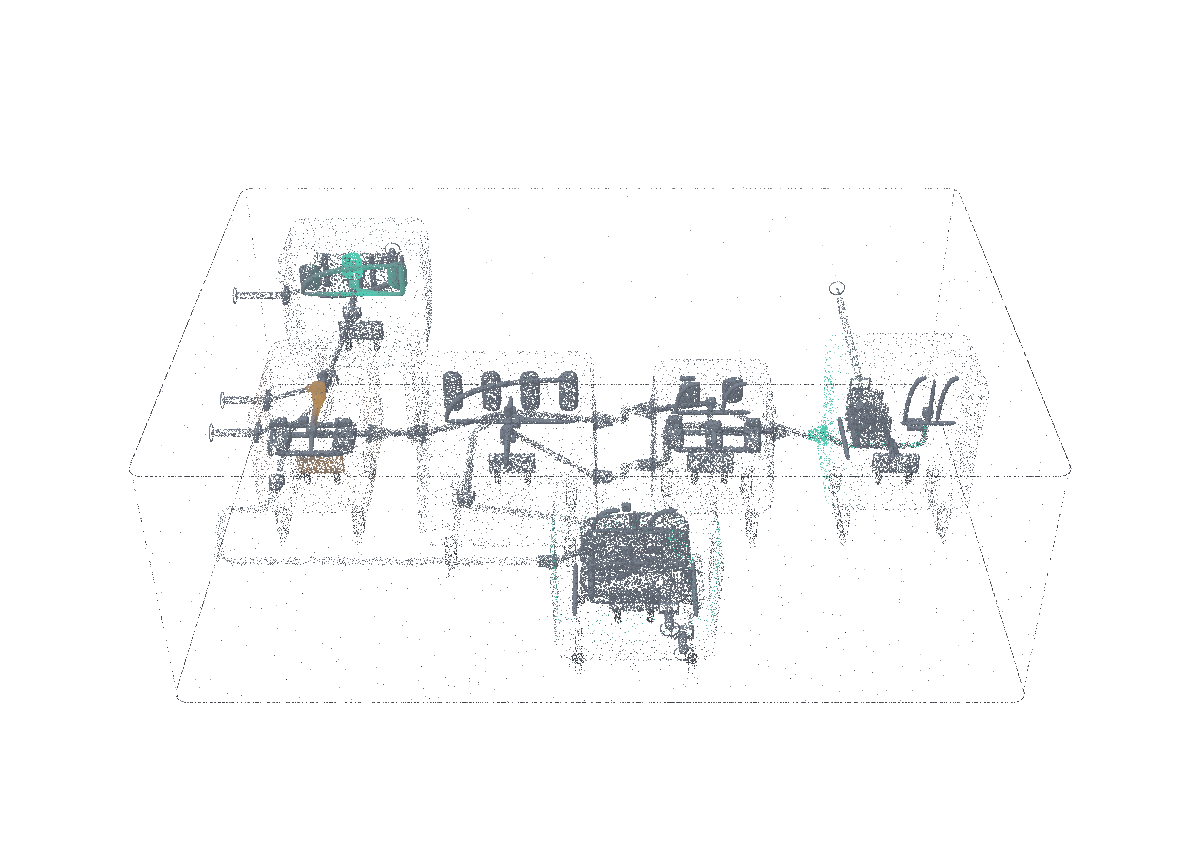
Technical descriptionsInteractive model unavailable. The static illustration and descriptions remain available. Brief and architecture Turn the desired workflow into responsibilities, interfaces and inspectable acceptance conditions. Technical data Inputs User workflow, constraints and desired outcome.
Transformation Turn the desired workflow into responsibilities, interfaces and inspectable acceptance conditions.
Retained state and outputs Objective, scope, ceiling, expiry and confirmed plan revision.
Task interfaces and acceptance basis.
Constraints The confirmed scope, acceptance basis and execution ceiling constrain the work.
Attempt and resource scheduler Bind one eligible attempt to its source and finite capacity. Technical data Inputs Confirmation bound to the exact proposed mandate.
Identified task and source/acceptance basis.
Accounting reservation retaining review capacity.
Retained task and next decision after uncertainty is resolved.
Transformation Bind one eligible attempt to its source and finite capacity.
Retained state and outputs Attempt, project, base and policy identity.
Separate implementation and challenge capacity; reservation is not permission.
Constraints Capacity reservation and permission are separate prerequisites.
Implementation bench Transform the task into an artifact and correct identified defects. Technical data Inputs One admitted bounded implementation attempt.
Source-bound unresolved finding; correction creates a new candidate.
Transformation Transform the task into an artifact and correct identified defects.
Retained state and outputs Exact source candidate and artifact.
Each correction produces a new candidate identity.
Constraints A correction creates an identifiable new candidate for examination.
Independent challenge Review and QA examine the same candidate through separate responsibilities. Technical data Inputs Exact candidate and artifact for independent examination.
Transformation Review and QA examine the same candidate through separate responsibilities.
Retained state and outputs Reviewer findings for the candidate.
Executed acceptance cases and required-check evidence.
Constraints Independent review and QA must address the same source candidate.
Exact-source comparator Join candidate, current base, policy, checks and independent verdicts. Technical data Inputs Separate verdict and required-check records for one candidate.
Current integration base and project policy.
Transformation Join candidate, current base, policy, checks and independent verdicts.
Retained state and outputs Candidate/base/policy identities.
Missing, failed and stale evidence remain distinct.
Constraints Missing, failed or stale evidence prevents acceptance.
Handover and continuity Preserve artifacts, unresolved work and original uncertain attempts for the next operator. Technical data Inputs Observed attempt result or retained uncertainty.
Source/artifact/check packet with remaining delivery decision.
Attributed evidence about the original uncertain attempt.
Transformation Preserve artifacts, unresolved work and original uncertain attempts for the next operator.
Retained state and outputs Objective, source, findings and next decision.
Original attempt observations; no replacement while uncertain.
Constraints An uncertain attempt is reconciled under its original identity before any replacement is considered.
An illustrative development process from bounded brief through candidate review and handover.
Additional mechanisms are described in the technical reference .
Start where the advantage matters. Six ways to turn a difficult operating problem into a system you can use.
Dedicated intelligence environment Knowledge and action are scattered across private systems.
What we build with you Source and identity map Versioned context model with memory and monitoring Admitted workflows and operator controls Deployment and recovery design How we judge the result Named tasks completed correctly with current context, appropriate permissions and recoverable results.
Discuss your environment Institutional memory and decision systems Teams repeatedly reconstruct decisions and lose the reasons behind them.
What we build with you Source-connected knowledge model Temporal recall and contradiction handling Attention rules and workflow integration A fixed question set for evaluating useful answers How we judge the result Correct evidence recovered and useful decisions supported on the agreed task set.
Discuss your institutional knowledge Persistent agents and operational autonomy Work needs to continue across events, tools and interruptions.
What we build with you Objective and mandate model Supervised processes and resource envelopes Intervention and recovery paths Task-level operating evaluation How we judge the result Accepted completion, recovery and intervention rate under stated conditions.
Scope a continuing agent Predictive operations and prevention Early signals are available but do not become timely decisions.
What we build with you History and condition model Uncertainty and decision scenarios Intervention workflow Prospective evaluation design How we judge the result Calibration, lead time, false alarms and adjudicated intervention outcomes.
Discuss a predictive operation AI products and software platforms A business needs a complete product with its own domain workflows.
What we build with you Product architecture and interface Service composition and integrations Roles, approvals and operational controls Tested release, documentation and handover How we judge the result Accepted user journeys, upgrade and recovery behavior, and maintainable integrations.
Discuss a product to build Private AI and compute-system design AI use depends on custody, location, capacity, energy or inference constraints.
What we build with you Deployment and custody design Compute and energy scenarios Integration prototype Operating model and measured capacity plan How we judge the result Named boundary tests, workload measurements and independently checked physical assumptions.
Discuss deployment and compute Scroll to explore · Esc to skip Read full card Built through Black Box. A clear chain from the work you need to the system you can operate. Each stage leaves something concrete to inspect.
Explore the development system Discover and define Map the workflow, sources, people, constraints and current baseline. Decide what a useful result would change.
System brief Outcome definition Data and rights boundary First architecture Prove the critical path Build one representative slice through the intended integrations or an agreed test environment. Examine failure cases before expanding the scope.
Working vertical slice Evaluation results Failure cases Decisions for the full system Build and integrate Implement the selected scope with review, acceptance and operational responsibilities attached to the exact release.
Reviewed software Integration contracts Operator controls Acceptance record Operate and improve Agree monitoring, support, recovery and change control. Evaluate improvements against actual tasks and retained baselines.
Operating handbook Recovery procedures Support responsibilities Review cadence A dedicated environment around your world. Naevum designs intelligence systems around your data, infrastructure, people and objectives. A versioned model of that world brings memory, reasoning and permitted action into the work you need to change.
The engagement chooses the relevant capabilities and evaluates them against real tasks. A bounded application, a knowledge layer or a deployment design may be the right place to start.
Choose the engagement that serves the problem. Six starting paths cover dedicated environments, institutional memory, persistent agents, predictive operations, complete AI products and private compute design. Each has concrete deliverables and an agreed basis for acceptance.
Research, simulation and organizational adoption can be scoped within those paths or as a distinct collaboration.
Built with the components behind the experience. A memory problem can be examined as temporal knowledge, retrieval and attention. A continuing workflow can be examined as purpose, resources, permissions and consequence. A compute design connects application needs to equipment and energy.
Black Box supplies the delivery discipline: discovery, a representative working slice, reviewed implementation and operational handover. Ownership, support and service scope are agreed for the engagement.
What could these mechanisms make possible for you?
Talk with Naevum