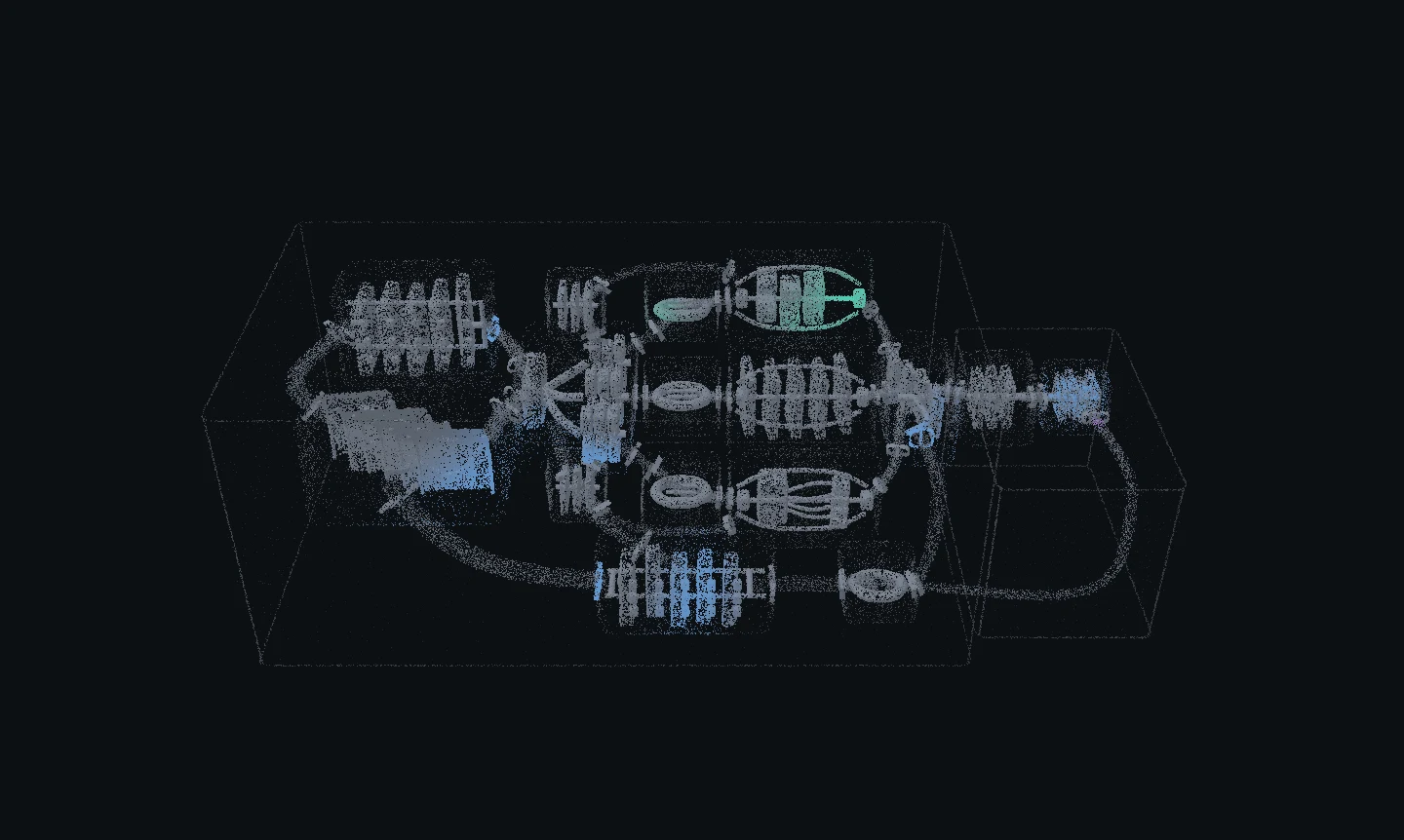
Synapse is a private model boundary for organizations that use outside AI models, so that each provider receives only what a task needs and each send through it is recorded.
Bio-inspired system
Enterprises & institutions
Private model calls
Security & privacy
Loading model
Local context
Retains original context and the record of prior exposure.
Source closure
Input is registered source material with an immutable identity, ancestry and holder binding. Closure walks the complete dependency ancestry and carries forward the most restrictive inherited labels. A derived fragment remains traceable to the exact material from which it was made.
The local source store retains the original content. Disclosure history is keyed to the relevant observer, so later requests can be considered against what that observer has already received or may have received.
Retained state
Payload objects are stored encrypted; operational metadata receipts omit their plaintext. The source identity, inherited constraints and observer history remain available to subsequent admission and reconciliation. Registration and selection prepare this state; outbound permission is decided at dispatch.
Local processing
Transforms local material before a view is proposed.
Stable request material
Local preparation transforms source material into the candidate payload and expected response shape. Capturing the request freezes a strict JSON wire representation, including the payload and schema, so mutable aliases cannot change the data after review.
This stable representation becomes part of the request’s reviewed binding. The transformation retains the source ancestry and inherited restrictions needed by the later admission check.
Preparation and eligibility
Planning can test whether candidate work is eligible for a supported route. Those results remain advisory and can become stale. The actual dispatch revalidates current bindings and reserves disclosure accounting before transport.
Compose and route
Composes a bounded request and binds its destination.
Exact dispatch binding
Composition joins the required local inputs and binds the captured payload to its source, canonical observer, provider/model and proposed operation. The reviewed dispatch is tied to the exact approval, policy epoch, expiry and effect identity.
Immediately before transport, the dispatch path revalidates those bindings and the applicable key/authority. A change to the request, destination or policy requires a decision under the current contract.
A proposed route becomes a reserved effect
The route is selected before a live reservation is made. Atomic observer accounting reserves the admitted units and applicable budget under the operation identity, then permits the transport path. Shared concurrent channels consult the same cumulative record.
Parallel check · upper
Checks an independently routed request before transport.
Complete channel admission
Input is a stable captured request bound to its source closure, canonical observer, provider/model, policy epoch, expiry and effect identity. Each channel revalidates the complete reviewed contract. The channels are parallel opportunities to apply that same contract, not alternative partial security checks.
Atomic reservation before transport
The observer ledger reserves the admitted units and applicable budget in an atomic SQLite transaction before outbound transport. Concurrent requests consult the same observer history, including prior and uncertain exposure. Canonical provider-observer accounting is part of this decision.
The output is either a reserved dispatch under the exact identity or a retained held state. Advisory plans and cached eligibility do not replace this live reservation.
Uncertain exposure remains accounted
If transport is interrupted, the operation and its possible exposure remain retained. Unknown usage is not zero. Existing receipt reconciliation or explicit abandonment operates on that identity; no automatic refund or new-identity retry follows from a missing reply.
Parallel check · middle
Checks an independently routed request before transport.
Complete channel admission
Input is a stable captured request bound to its source closure, canonical observer, provider/model, policy epoch, expiry and effect identity. Each channel revalidates the complete reviewed contract. The channels are parallel opportunities to apply that same contract, not alternative partial security checks.
Atomic reservation before transport
The observer ledger reserves the admitted units and applicable budget in an atomic SQLite transaction before outbound transport. Concurrent requests consult the same observer history, including prior and uncertain exposure. Canonical provider-observer accounting is part of this decision.
The output is either a reserved dispatch under the exact identity or a retained held state. Advisory plans and cached eligibility do not replace this live reservation.
Uncertain exposure remains accounted
If transport is interrupted, the operation and its possible exposure remain retained. Unknown usage is not zero. Existing receipt reconciliation or explicit abandonment operates on that identity; no automatic refund or new-identity retry follows from a missing reply.
Parallel check · lower
Checks an independently routed request before transport.
Complete channel admission
Input is a stable captured request bound to its source closure, canonical observer, provider/model, policy epoch, expiry and effect identity. Each channel revalidates the complete reviewed contract. The channels are parallel opportunities to apply that same contract, not alternative partial security checks.
Atomic reservation before transport
The observer ledger reserves the admitted units and applicable budget in an atomic SQLite transaction before outbound transport. Concurrent requests consult the same observer history, including prior and uncertain exposure. Canonical provider-observer accounting is part of this decision.
The output is either a reserved dispatch under the exact identity or a retained held state. Advisory plans and cached eligibility do not replace this live reservation.
Uncertain exposure remains accounted
If transport is interrupted, the operation and its possible exposure remain retained. Unknown usage is not zero. Existing receipt reconciliation or explicit abandonment operates on that identity; no automatic refund or new-identity retry follows from a missing reply.
Scoped work · array
Processes only the admitted view for this request.
Bounded input and execution
The array depicts independently organized work over an admitted input view. Source closure, observer, model and effect identity define what the request is allowed to send and which response is expected. The work does not inherit the complete local source merely by sharing a route.
For supported coding profiles, a bounded interpreter can operate on a closed AST and explicitly permitted constructs. The interpretation and independent review are profile-specific; they do not extend to arbitrary code or unrestricted tools.
Produced observation
The result returns with its recorded identity and usage information. Local response validation and review determine how it can be used. It remains distinct from an application effect and its separately granted authority.
Scoped work · layers
Processes only the admitted view for this request.
Dependency-ordered work
The layers depict bounded work with explicit prerequisites. A cell plan follows required dependencies backward from the requested result, retains the necessary closure and prunes work outside that closure.
Eligibility and capacity states help determine a proposed schedule. Planning makes no provider call and grants no permission; each actual outbound dispatch is admitted and reserved under its current contract.
An accounted result
Each admitted operation retains its identity, expected response shape and accounting record. Its returned observation proceeds to local checking and reconciliation before it is incorporated into the continuing record.
Scoped work · core
Processes only the admitted view for this request.
Scoped interpretation and review
The core/register form depicts a supported unit of work whose input and expected output are bounded. In a qualified coding profile, the code boundary can be a closed AST interpreted under an explicit set of allowed operations, followed by independent review.
The supported profile defines the grammar, resource limits and available effects. This role map deliberately leaves those values profile-specific rather than treating one fixture’s limits as universal.
Output binding
The response is related to the exact request and evaluated as untrusted data. Current schema, bounds and intended use govern acceptance; a response cannot replace the authority that admitted the request.
Return check
Treats returned observations as untrusted until checked.
Response validation
Input is a returned observation associated with an existing operation. The local return path checks expected structure, response bounds and the current control bindings before the observation is used. The response remains untrusted throughout that check.
The encrypted response payload and the metadata receipt serve different purposes: content is recovered for validation, while identity, state and usage support accounting and audit without placing plaintext into routine receipts.
Interrupted transport
An absent response or unknown usage remains uncertain. Unknown usage is not zero, and an interrupted outcome does not refund possible disclosure. The same operation remains available for recovery or explicit abandonment with its accounting retained.
Reconciliation and history
Relates observations and consequences to the same originating identity.
Reconcile the existing operation
Reconciliation takes an authenticated broker response already recorded as received, checks the exact source/observer/effect identity and retrieves that result. This path makes no new provider call.
The returned observation or consequence is related to the originating record, preserving source ancestry and cumulative disclosure history. Result state and exposure accounting remain separate facts.
A retained unresolved state
When transport remains uncertain, the record preserves that uncertainty. Abandonment retains disclosure accounting and does not schedule an automatic retry. Recovery works on the existing identity rather than creating a fresh identity to bypass a held outcome.
Result control
Separates checked observations from proposals for application effects.
Result validation and disposition
The comparison banks receive checked model observations and evaluate their intended use against current bounds and authority. One disposition is to reconcile the observation into the local record. Another is to present a proposal for an application effect.
That proposal needs the owning application’s separate authorization. Model inference supplies data; it does not grant the effect permission that would allow an edit, command or physical action.
Two accountable paths
The checked-return branch preserves the result’s existing identity. The authorized-output branch carries an independently permitted application operation, then returns its output or reported consequence through the checking path.
Application executor
Performs only an independently authorized application effect.
Independently authorized effect
Input is a proposal admitted by the owning application’s effect policy, with an exact scope and operation identity. The executor acts only under that separate permission; inference approval and effect approval are different decisions.
In supported edit workflows, a validated response can become an encrypted local proposal for review. Applying that proposal is a further bounded application action, not an implicit consequence of receiving model text.
Output and retained evidence
The application records its output and reported consequence under the effect identity. The illustration sends that evidence back through checking and reconciliation so local history can relate the action to its request.
Output and receipt
Records the output and consequence of that authorized effect.
A consequence record
The output register receives application output, receipt metadata and any reported consequence from the independently authorized effect. The record carries identity and state so later reconciliation can determine which operation produced the observation.
A receipt establishes what the reporting system recorded. Physical or external completion needs the evidence appropriate to that application; the receipt alone is not a universal physical-success guarantee.
Return to the originating history
Consequences return through the local checking path and join the same continuing record. Missing or uncertain results remain represented as such, while disclosure accounting is retained separately.
Adaptive check · upper
Adds a temporary checking route while requests need it.
Required work and available capacity
An advisory cell plan walks required dependencies backward from the requested result, retains the dependency closure and prunes unrelated work. Eligibility, held and capacity states describe which bounded route could serve the request. Planning itself makes no provider call and grants no authority.
The additional checking bay visualizes this on-demand allocation. Shared users retain the same allocation until all in-flight work and receipts drain; a new user cannot reset or withdraw a live route.
Complete channel admission
Input is a stable captured request bound to its source closure, canonical observer, provider/model, policy epoch, expiry and effect identity. Each channel revalidates the complete reviewed contract. The channels are parallel opportunities to apply that same contract, not alternative partial security checks.
Atomic reservation before transport
The observer ledger reserves the admitted units and applicable budget in an atomic SQLite transaction before outbound transport. Concurrent requests consult the same observer history, including prior and uncertain exposure. Canonical provider-observer accounting is part of this decision.
The output is either a reserved dispatch under the exact identity or a retained held state. Advisory plans and cached eligibility do not replace this live reservation.
Adaptive check · lower
Adds a temporary checking route while requests need it.
Required work and available capacity
An advisory cell plan walks required dependencies backward from the requested result, retains the dependency closure and prunes unrelated work. Eligibility, held and capacity states describe which bounded route could serve the request. Planning itself makes no provider call and grants no authority.
The additional checking bay visualizes this on-demand allocation. Shared users retain the same allocation until all in-flight work and receipts drain; a new user cannot reset or withdraw a live route.
Complete channel admission
Input is a stable captured request bound to its source closure, canonical observer, provider/model, policy epoch, expiry and effect identity. Each channel revalidates the complete reviewed contract. The channels are parallel opportunities to apply that same contract, not alternative partial security checks.
Atomic reservation before transport
The observer ledger reserves the admitted units and applicable budget in an atomic SQLite transaction before outbound transport. Concurrent requests consult the same observer history, including prior and uncertain exposure. Canonical provider-observer accounting is part of this decision.
The output is either a reserved dispatch under the exact identity or a retained held state. Advisory plans and cached eligibility do not replace this live reservation.
Local context stays active while independent requests use primary or adaptive checks. Each result returns through validation; application effects require their own authority.
A local request composes and processes context, then updates the same record without an external work route.
A bounded view passes a checking channel to scoped work. The returned observation is checked and reconciled with its originating record.
A separately authorized application effect follows result validation. Its output and consequence return through checking and reconciliation.
Technical descriptions
Each proposed view is checked against what its observer has already received and what remains unresolved.
The open question is whether anyone can see what left, and to whom.
Breaches at organizations with high shadow-AI use cost $670,000 more on average. The figure describes model use nobody sanctioned and nobody recorded. Synapse turns it into sanctioned, recorded use: a policy owner decides what may leave, and each call is checked against its source and against what its destination has already seen.2
One task. A carefully chosen view.
An institution wants a model to help with a document. The institution holds much more information than that task requires.
The source owner assigns permitted information classes. Before dispatch, the capability fixes the observer and model, task policy, expiry and stopping conditions. The receiving model does not grant itself that authority.
Bind the source
Register the context against an immutable source snapshot and its provenance. Holder, actor, client and workspace identify the intended setting.
Starts with
An identified source and a bounded task.
Produces
A context record that can be examined.
Choose the observer
The destination and what it has already received matter to disclosure. Registering context does not itself authorize transmission.
Reserve the effect
Reserve task identity and cumulative call and byte allowances before transport. Concurrent work must account for the same finite budget.
A series of small views can reveal a larger picture.
A useful disclosure boundary considers the observer’s cumulative history.
Two individually limited requests may expose more together than either does alone. Synapse tracks what a particular observer has already received across effects, so admission can account for that accumulated view.
Source selection, task policy and allowed effects are distinct decisions. A supported coding projection also needs validation of returned edits and a recovery path back to the source. Each integration must specify the transformations and languages it supports.
Can the board pack go to an external model?
The CFO sets what may leave; the boundary applies that rule on every send. Illustrative.
1 of 5The finance team sends the board pack draft and its sources toward an external model for a summary.
2 of 5The boundary checks what this model provider has already received from the company before anything crosses.
3 of 5The clause on a pending acquisition stays local; the rest of the draft crosses to the model.Decision: The CFO’s policy keeps acquisition terms inside the company.
4 of 5The model’s summary returns through validation before anyone in finance relies on it.
5 of 5The send is recorded under its identity, and the CFO decides whether the summary goes into the board pack.Decision: The CFO accepts or rejects the summary.
Select any part of the drawingScroll to step · Esc to skipFig. 1
1 of 5A procurement lead asks an external model to summarize the liability clause of a supplier contract.
2 of 5The boundary finds that this provider already received the contract’s pricing annex for an earlier task.
3 of 5Together, the clause and the annex would reveal the supplier’s full terms, so the boundary holds the clause.Decision: The CFO’s policy forbids that combination for one provider.
4 of 5The procurement lead sees why and sends a narrower request without the supplier’s name; this one passes.Decision: The procurement lead chooses the narrower request.
5 of 5The held attempt and the send are both recorded, so the provider’s history stays accurate for the next request.
Select any part of the drawingScroll to step · Esc to skipFig. 1
1 of 5The boundary passes a quarterly summary and reserves the send under one identity before it crosses.
2 of 5The connection drops after sending: the model may have read the summary, yet no answer arrives.
3 of 5The send stays on record as uncertain, and the summary counts as seen by this provider.
4 of 5Reconciliation checks the existing send and its receipts under the same identity before any copy goes out again.
5 of 5The finance controller decides whether to repeat or abandon the request, knowing the provider may already hold it.Decision: The controller repeats or abandons the request.
Select any part of the drawingScroll to step · Esc to skipFig. 1
Where it changes the work.
Illustrative situations, connected to the mechanisms that make them possible.
Use outside intelligence on a bounded task
Institutions and R&D teams
A useful model needs context, while the organization holds a much larger sensitive source.
How it works
Select a source-bound projection and account for its disclosure to the actual observer before dispatch.
What changes
The organization can inspect the approved context, purpose and destination of the model work.
Recover an interrupted agent attempt
Software teams
A connection drops after a request may already have reached its provider.
How it works
The durable effect remains uncertain and reuses its exact identity during reconciliation.
What changes
Recovery can establish what happened without silently repeating an action or forgetting prior exposure.
Put a budget on an inference route
Compute operators
Concurrent requests can pass a separate check before either has charged its usage.
How it works
Transactional reservation binds admission to the request, with settlement linked to received evidence.
What changes
The inference route has a durable basis for concurrent resource accounting.
A connection disappears after dispatch. The model may have received the context even though its result never arrived.
Keep the identity
The job, step, source and policy binding remain attached to the effect.
Reconcile before repeating
Inspect the existing effect and its receipts. A fresh identifier cannot safely stand in for an unresolved attempt.
Recover with the record
Received results, interrupted work and abandonment retain their disclosure history. A recovery decision follows the known state.
Questions about Synapse.
Does Synapse protect every model, IDE and operating-system route?
Coverage is specified for each supported integration and deployment. A protected task route does not establish universal IDE interception or complete operating-system containment.
What does a dedicated deployment add?
It can change custody, compute location and the parties involved. Context admission, observer history and action controls still need to be designed and tested for that deployment.
Technical reference6 mechanisms · 1 further section
The mechanisms underneath.
The technical choices that give Synapse its particular behavior.
Immutable context admission
Context is bound to a source snapshot, provenance, holder, actor, client and workspace. Registration and disclosure authority remain distinct.
Cumulative observer history
Admission can consider what a destination has already received across several effects.
Reserve before transport
Effect identity and cumulative call and byte allowances are reserved before dispatch, including concurrent work.
Source and effect binding
Results belong to the job, step, source and policy they concern. Deduplication and recovery use that identity.
Durable uncertainty
An interrupted effect retains its history until reconciled. Abandonment does not erase disclosure.
Bounded transformation and recovery
Source selection, restricted projection, recovery objects and returned-edit validation have explicit supported-route and language limits.
One task. A carefully chosen view.
Synapse binds model work to an identified source, a chosen observer and a permitted effect. Cumulative disclosure history and durable recovery preserve the meaning of a task when work is concurrent or interrupted.
Bind the source. Register the context against an immutable source snapshot and its provenance. Holder, actor, client and workspace identify the intended setting.
Choose the observer. The destination and what it has already received matter to disclosure. Registering context does not itself authorize transmission.
Reserve the effect. Reserve task identity and cumulative call and byte allowances before transport. Concurrent work must account for the same finite budget.
Synapse in operation.
Synapse is used in Naevum’s engineering workflows. The context, admission and recovery mechanisms described here retain their own supported-route scope.