Manna is a continuing agent for owner-operators and industrial teams, so that work on your goal continues while you are away and your decisions wait for you.
Cybernetic organism
Personal & industrial
Level 4–5 autonomy
Self-regulation
Loading model
Purpose and progress
Compare observed progress with a retained objective without equating a completed operation with objective achievement.
Inputs
Recorded progress, distinct from objective achievement.
Transformation
Compare observed progress with a retained objective without equating a completed operation with objective achievement.
Retained state and outputs
Declared objective and envelope remain fixed until an explicit revision.
Observed progress is retained separately from the objective and its evaluation horizon.
Constraints
A completed operation is evidence of progress; the continuing objective still needs its own evaluation.
Evidence and contextual memory
Align selected sources with retained context, validity and unresolved gaps.
Inputs
Identified observation with source/event time and validity.
Retained reviewed material and outline, not a new source observation.
Transformation
Align selected sources with retained context, validity and unresolved gaps.
Retained state and outputs
Source cursor, event time and applicability.
Reviewed source records and outline remain visible.
Quiet, absent, stale and retracted evidence remain distinct.
Constraints
Quiet, missing, stale and retracted evidence have different meanings.
Attention and condition regulation
Allocate finite work and pacing from purpose, known resource condition and retained faults.
Inputs
Known resource readings or explicit unknown channels.
Declared priorities and due-work scope.
Fault/progress evidence; pending approval is not a fault.
Transformation
Allocate finite work and pacing from purpose, known resource condition and retained faults.
Retained state and outputs
Unknown resource channels remain unknown.
Eligible work allocation and protected-obligation scope.
Repeated body faults differ from waiting for a person.
Constraints
Unknown resource conditions stay unknown, and protected obligations remain within their declared scope.
Specialised workbench
Transform source material and retained context into a useful revised artifact.
Inputs
The specific research question and declared flow.
Eligible source/context bundle with provenance.
Admitted finite work and pacing; pressure does not expand authority.
Transformation
Transform source material and retained context into a useful revised artifact.
Retained state and outputs
Chosen evidence and its provenance.
The lighter analysis and remaining uncertainty.
Revised brief and unresolved question.
Constraints
The revised artifact retains its source basis and unresolved questions.
Bounded effect interface
Hold an identified external request, couple only its applicable grant, and issue one admitted action.
Inputs
One external data request with stable identity.
Applicable scope and operating limits.
An independent grant naming the exact request.
Transformation
Hold an identified external request, couple only its applicable grant, and issue one admitted action.
Retained state and outputs
Exact request, target and scope.
Independent matching authority and envelope.
Original action identity; zero idle actuation.
Constraints
The exact request needs its applicable independent grant before the output can move.
Consequence and continuity
Retain work results, action records, independent evidence and unfinished obligations across continuation.
Inputs
A revised local brief and remaining question.
The named admitted attempt; not proof of an observed consequence.
An identified receipt or retained uncertainty.
Later observed consequence, separately evaluated.
Transformation
Retain work results, action records, independent evidence and unfinished obligations across continuation.
Retained state and outputs
Expected effect, actual receipt and observed consequence remain distinct.
Causal ancestry, original pending action and earlier results.
Required state and behavioral continuity checks; replay alone is insufficient.
Constraints
An uncertain action keeps its original identity. A receipt and a later consequence remain separate evidence.
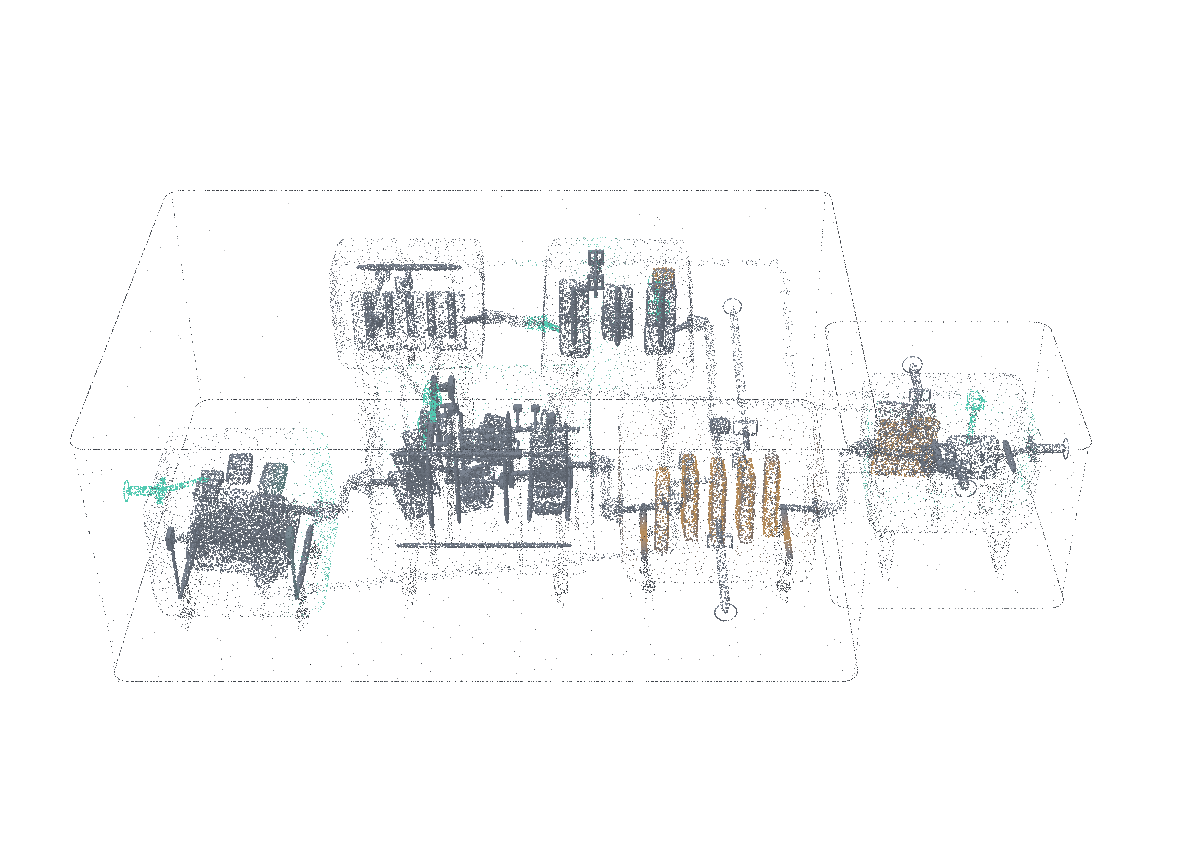
Technical descriptionsInteractive model unavailable. The static illustration and descriptions remain available.
Purpose and progress
Compare observed progress with a retained objective without equating a completed operation with objective achievement.Technical data
Inputs
Recorded progress, distinct from objective achievement.
Transformation
Compare observed progress with a retained objective without equating a completed operation with objective achievement.
Retained state and outputs
Declared objective and envelope remain fixed until an explicit revision.
Observed progress is retained separately from the objective and its evaluation horizon.
Constraints
A completed operation is evidence of progress; the continuing objective still needs its own evaluation.
Evidence and contextual memory
Align selected sources with retained context, validity and unresolved gaps.Technical data
Inputs
Identified observation with source/event time and validity.
Retained reviewed material and outline, not a new source observation.
Transformation
Align selected sources with retained context, validity and unresolved gaps.
Retained state and outputs
Source cursor, event time and applicability.
Reviewed source records and outline remain visible.
Quiet, absent, stale and retracted evidence remain distinct.
Constraints
Quiet, missing, stale and retracted evidence have different meanings.
Attention and condition regulation
Allocate finite work and pacing from purpose, known resource condition and retained faults.Technical data
Inputs
Known resource readings or explicit unknown channels.
Declared priorities and due-work scope.
Fault/progress evidence; pending approval is not a fault.
Transformation
Allocate finite work and pacing from purpose, known resource condition and retained faults.
Retained state and outputs
Unknown resource channels remain unknown.
Eligible work allocation and protected-obligation scope.
Repeated body faults differ from waiting for a person.
Constraints
Unknown resource conditions stay unknown, and protected obligations remain within their declared scope.
Specialised workbench
Transform source material and retained context into a useful revised artifact.Technical data
Inputs
The specific research question and declared flow.
Eligible source/context bundle with provenance.
Admitted finite work and pacing; pressure does not expand authority.
Transformation
Transform source material and retained context into a useful revised artifact.
Retained state and outputs
Chosen evidence and its provenance.
The lighter analysis and remaining uncertainty.
Revised brief and unresolved question.
Constraints
The revised artifact retains its source basis and unresolved questions.
Bounded effect interface
Hold an identified external request, couple only its applicable grant, and issue one admitted action.Technical data
Inputs
One external data request with stable identity.
Applicable scope and operating limits.
An independent grant naming the exact request.
Transformation
Hold an identified external request, couple only its applicable grant, and issue one admitted action.
Retained state and outputs
Exact request, target and scope.
Independent matching authority and envelope.
Original action identity; zero idle actuation.
Constraints
The exact request needs its applicable independent grant before the output can move.
Consequence and continuity
Retain work results, action records, independent evidence and unfinished obligations across continuation.Technical data
Inputs
A revised local brief and remaining question.
The named admitted attempt; not proof of an observed consequence.
An identified receipt or retained uncertainty.
Later observed consequence, separately evaluated.
Transformation
Retain work results, action records, independent evidence and unfinished obligations across continuation.
Retained state and outputs
Expected effect, actual receipt and observed consequence remain distinct.
Causal ancestry, original pending action and earlier results.
Required state and behavioral continuity checks; replay alone is insufficient.
Constraints
An uncertain action keeps its original identity. A receipt and a later consequence remain separate evidence.
Purpose, evidence and available attention guide the workbench. Revised work enters the journal and informs the next comparison; external requests wait for their applicable grant.
Describe purpose, means, operating envelope and the flow of work in an inspectable genome.
Select relevant material, compare it with retained context, and assemble a revised artifact. Keep the result and unfinished work in the journal.
Present an identified request under its declared envelope. Couple the applicable grant before acting, then retain the action and independent evidence of its outcome.
The length of tasks agents complete reliably has been doubling for six years.
METR's measurements show agents finishing ever longer software tasks, and its newest report places the frontier higher still, with wide uncertainty. Longer unattended work means more effects nobody watched, so Manna holds each effect against the limits its owner set and keeps a causal history for the owner's return.
The project continues. The conditions change.
You leave a research task unfinished. When you return, its objective still exists, the available resources have changed, and an outstanding decision needs you.
Manna gives a continuing agent an internal organization. Its genome states purpose and laws. Specialized cells and pipelines describe how work happens, while a journal records the consequences of admitted actions.
A Personal agent can carry a project between sessions. An Industrial system needs an operating mandate around a process, its equipment and the people responsible for it. The editions share a language; their responsibilities differ.
Keep a goal moving while its owner is away
The owner sets the objective and its limits; Manna works inside them and holds anything larger for the owner. Illustrative.
1 of 4Before leaving, the owner declares the objective, the budget and which effects need a personal approval.Decision: The owner sets the limits.
2 of 4Manna continues the research inside those limits and writes each step, with its cause, to the history.
3 of 4A paid request for outside data exceeds the budget, so Manna prepares it and holds it for the owner.
4 of 4Back at the desk, the owner reads what changed and why, then approves or refuses the waiting request.Decision: The owner approves or refuses the request.
Select any part of the drawingScroll to step · Esc to skipFig. 2
1 of 4The plant manager writes the mandate for Plant 2: permitted adjustments, equipment limits and who answers for exceptions.Decision: The plant manager sets the mandate.
2 of 4Within the mandate, Manna adjusts pacing to the line's measured load and records every change with its reason.
3 of 4A setpoint change beyond the mandate is proposed and held for the shift engineer.
4 of 4The shift engineer approves the change, and the history links it to its reason and its approver.Decision: The shift engineer approves or rejects the change.
Select any part of the drawingScroll to step · Esc to skipFig. 2
1 of 4Overnight, a supplier quote arrives that would commit money beyond the owner's limit.
2 of 4Manna prepares the comparison the owner will need and stops before any commitment is made.
3 of 4The owner receives one message: the proposal, its evidence and the limit it exceeds.
4 of 4Until the owner answers, the commitment stays open in the history and nothing is sent to the supplier.Decision: The owner decides whether to commit.
Select any part of the drawingScroll to step · Esc to skipFig. 2
Inside the mechanism. Resume the project. Keep the outstanding decision.
Illustrative scenario. A research project pauses while resource availability changes. Continuation preserves its purpose and responsibilities.
The project has useful work and an unresolved approval.
The journal connects the objective, the completed source review and a proposed external action.
Purpose
Prepare an evidence-backed research brief.
Completed
Source review and a draft outline.
Outstanding
Owner approval for an external data request.
Resource state
A compute-heavy analysis is still pending.
A smaller work allocation preserves the same obligation.
Resource observations can change pacing or the proposed organ. They do not settle the owner’s outstanding decision.
Continue
Retain the source review, outline and causal ancestry.
Adapt
Prepare the lighter analysis under the current resource envelope.
Keep pending
The external request still needs owner approval.
Check
Probe the restored behavior and verify any proposed rollback separately.
Where it changes the work.
Illustrative situations, connected to the mechanisms that make them possible.
A project that continues tomorrow
Personal edition
A person has a continuing objective spread across sessions, files and decisions.
How it works
A genome retains the objective and envelope; heartbeats and memory resume work with its earlier context.
What changes
The next session can begin with the objective, prior decisions and outstanding approvals already connected.
A process with a safe stopping point
Industrial edition
An operational process must react to observations while respecting equipment and responsibility boundaries.
How it works
A pipeline separates perception, proposal and gated action; the journal records the resulting state.
What changes
Operators can inspect why a step was admitted, stop the process and recover from its record.
Specialists working toward one purpose
Engineering teams
Several specialized agents need a shared direction and finite resources.
How it works
Constellations combine bounded mandates with attention allocation and fault isolation.
What changes
A failure or urgent signal can be addressed locally while the broader objective remains intact.
Scroll to explore · Esc to skip
An agent should notice its own condition.
Load, memory pressure and thermal observations can change how a continuing system allocates its attention.
Sense the condition
Interoception reads resource observations and preserves missing measurements as unknown. A pressure model can increase vigilance or lengthen the interval between ticks.
Protect the obligation
Attention allocation can protect due commitments, limit one organ’s share and expose capabilities lost under resource pressure. Dwell and hysteresis reduce unstable switching.
Admit the action
A pipeline separates observation and proposals from effects. Its operating envelope and gates determine which action may happen; extra urgency does not expand that authority.
Resume the purpose, with its history intact.
Recovery is an engineering question: which state, obligations and behavior must survive?
Retain ancestry
Journal ancestry and required state connect a successor to the work it continues.
Change an organ deliberately
A new organ starts from a reviewed template, reserves resources and retains its identity through activation. Retirement checks for outstanding obligations and protected functions before the organ can leave.
Starts with
A proposed capability and its declared resource cost.
Produces
An admitted lifecycle transition with the continuing purpose preserved.
Condition
A pending human decision remains pending after the transition.
Examine behavior
Behavioral probes and self-description contribute to continuity checks. A process starting again is only one part of recovery.
Judge the objective
Execution, artifact quality and objective achievement answer different questions. A useful outcome needs units, a time horizon, a baseline and an evaluator.
Prove a rollback
A rollback certificate records the intended restoration; a separate check must establish what was actually restored. External consequences remain part of the history.
Condition
Structure, policy, artifact quality and useful outcomes retain separate assurance judgments.
Prediction and growth have their own research questions.
Manna explores bounded lookahead, supervised organ lifecycles and resource-aware development.
Manna’s predictive organ currently studies synthetic scheduling. Forecasts enter a ledger before outcomes arrive, so an experiment can test whether bounded lookahead improves the later decision.
A personal or industrial engagement selects its capabilities around the actual operating task and evaluates their contribution.
Questions about Manna.
What belongs in Personal Manna?
Continuing work around a person’s projects: retain an objective, observe relevant changes, prepare useful work and return decisions that require the person’s authority.
How does Industrial Manna differ?
Its mandate is designed around an operating process, resources, permitted interventions and recovery responsibilities. Equipment integration and task acceptance are evaluated for the intended setting.
Technical reference6 mechanisms · 2 further sections
The mechanisms underneath.
The technical choices that give Manna its particular behavior.
Constitutional composition
A supervisor can examine the union of laws within a defined fragment while organisms retain their journals and failure domains.
Resource-aware regulation
Load, memory and thermal observations inform a declared pressure model. Missing measurements remain unknown.
Attention with protected obligations
An allocator can preserve due work, limit an organ’s share and expose lost capabilities. Dwell and hysteresis reduce unstable switching.
Continuity checks
Journal ancestry, required state, behavioral probes and self-description contribute to checking a successor against the work it continues.
Bounded predictive research
A synthetic scheduling organ records forecasts before outcomes and studies lookahead under uncertainty. Its scope is distinct from a general-purpose world model.
Outcome-aware evaluation
Structure, policy, artifact and objective achievement have separate meanings. An objective needs units, horizon, baseline and an evaluator.
The project continues. The conditions change.
Manna gives a continuing agent purpose, an internal organization and a way to regulate its work. Personal and Industrial editions connect explicit laws, sensing, memory, admitted action and recovery to different operating responsibilities.
An agent should notice its own condition.
Sense the condition. Interoception reads resource observations and preserves missing measurements as unknown. A pressure model can increase vigilance or lengthen the interval between ticks.
Protect the obligation. Attention allocation can protect due commitments, limit one organ’s share and expose capabilities lost under resource pressure. Dwell and hysteresis reduce unstable switching.
Admit the action. A pipeline separates observation and proposals from effects. Its operating envelope and gates determine which action may happen; extra urgency does not expand that authority.
Manna in operation.
Manna runs continuously in a controlled environment. It has made millions of decisions and observations and has learned its host’s operating patterns through observation and self-improvement. Industrial applications have their own operating mandate, equipment integration and acceptance.