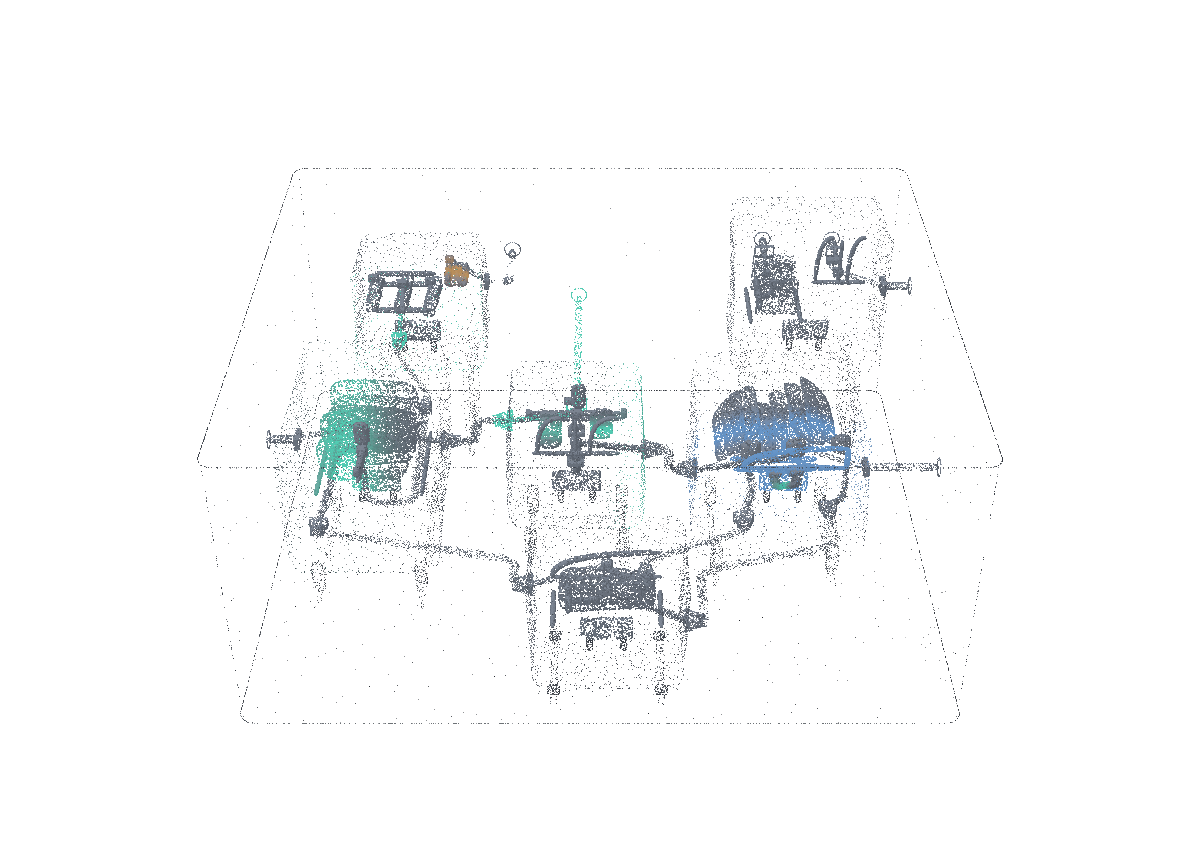
Dated records support recall of both earlier and current knowledge. Changes accumulate into attention, while later outcomes are compared with retained estimates.
Keep episodes, lessons, claims and failure memory with their provenance and holder.
Integrate signals over time, with decay, refractory behavior and explicit unknown states.
Compare a retained estimate with a later identified outcome. Keep uncertainty and useful failures available for the next decision.
An organization should not have to learn the same lesson twice.
of workers say they often have to ask someone or call a meeting to get what they need
More than half of workers say asking a colleague is often the only way to get the information they need. When that colleague leaves, the answer leaves too: across 110 studies, higher staff turnover goes with lower organizational performance, a modest link. In one benchmark, commercial chat assistants lost 30% accuracy recalling information across sustained interactions, so a conversation log is a weak substitute. Vagus records each decision with its date, its authority and its sources, so the answer stays when the person goes.123
What did we know when we made the decision?
A delivery date moves. The new date is current, but the old commitment still explains yesterday’s plan.
At the earlier date
A temporal claim is resolved within its validity interval. A historical question can recover the claim that applied at that time.
Context
The original commitment and its supporting source.
Experience
The answer appropriate to the earlier decision.
With today’s evidence
A replacement claim changes the current answer. Source pointers and contested claims preserve the reason for that change.
Context
A revised commitment, its source and effective date.
Experience
The current answer alongside the changed history.
Which change deserves attention now?
A large organization produces more signals than anyone can examine individually.
Accumulate relevance
Signals charge a subject’s attention potential. Decay, thresholds and refractory periods shape when it becomes worth examining.
Notice missing visibility
A quiet source and an unobserved source are different conditions. Missing observability can itself contribute an attention signal.
Remember the failure
Measured harms create decaying failure contexts. Hysteresis can preserve appropriate caution as conditions change; a warning cannot grant a new capability.
Why did we choose this supplier two years ago?
The COO asks; memory answers with the decision, its date, its authority and the sources of that time. Illustrative.
1 of 4The COO asks why the company chose Supplier B, and the question names that decision.
2 of 4Memory finds the decision with its date and its authority: the operations board approved it.
3 of 4Memory reads the sources as they stood that day: Supplier B’s offer at the time, not today’s price list.
4 of 4The answer shows who decided, when and on what; the later price list appears beside it, marked as newer.Decision: The COO decides whether the old reasons still hold.
Select any part of the drawingScroll to step · Esc to skipFig. 1
1 of 4Finance asks whether a conference expense approved last spring broke the travel policy.
2 of 4Memory reads the policy as of the approval date: version 3, which allowed the expense.
3 of 4Version 4 tightened the rule afterward; memory shows that change with its own date and source.
4 of 4The answer separates the rule then from the rule now, and the COO decides how practice changes from here.Decision: The COO sets practice for future trips.
Select any part of the drawingScroll to step · Esc to skipFig. 1
1 of 4A project lead takes over and asks why the delivery date moved before they joined.
2 of 4Memory finds the decision to accept the delay, with its date and the manager who made it.
3 of 4The client’s sign-off from that week comes back as the source; today’s schedule is shown separately.
4 of 4The new lead gets who decided, when and on what, and decides whether that agreement still binds.Decision: The new lead decides whether the agreement still binds.
Select any part of the drawingScroll to step · Esc to skipFig. 1
Inside the mechanism. Monday’s decision, Thursday’s knowledge.
Illustrative scenario. An internal delivery commitment changes. Examine the earlier decision and the present recommendation without rewriting history.
The earlier plan used the commitment then in force.
A historical question resolves the claim valid on Monday and retains the document that supported it.
Question
Why did we reserve the launch window?
Valid claim
Delivery was scheduled for Friday.
Source
The original supplier commitment.
Decision
Keep the Friday launch reservation.
The recommendation changes with the new evidence.
The revised source changes the current answer. The earlier commitment still explains Monday’s work.
Current claim
The supplier now commits to Tuesday.
Attention
The changed dependency can cross the configured attention threshold.
Next decision
Revisit the launch reservation with the project owner.
Outcome test
Record the expected delay before observing the actual delivery.
Where it changes the work.
Illustrative situations, connected to the mechanisms that make them possible.
An institution remembers its decisions
Institutions
A policy changes, but earlier claims and the reasons for past decisions still matter.
How it works
Validity intervals, authority ancestry and contested claims preserve the history of understanding.
What changes
A new decision can distinguish the current position from an earlier or unsupported one.
Attention across a technical estate
Engineering organizations
Signals arrive from many projects, workers and resource windows.
How it works
Temporal attention integrates repeated observations and uses failure and outcome memory.
What changes
The operator sees why a matter deserves attention without treating every new observation as an emergency.
Learn which work succeeds
Operational teams
Different attempts consume different resources and produce different outcomes.
How it works
Outcome predictions and delayed reward joins retain the task and source behind each observation.
What changes
Selection can improve from recorded experience while the operator keeps control of authority.
Scroll to explore · Esc to skip
Experience should carry its uncertainty.
Vagus connects memory and attention to estimates of task outcomes, elapsed time and resource use.
Predictions of task outcomes, elapsed time and resource use enter the record before the outcome arrives. Later observations test the original estimate; they cannot silently replace it with a prediction written after the fact.
Hierarchical models can share evidence across a portfolio, organization, project and worker while retaining the uncertainty of a small sample. Worker selection can explore eligible options; an empty evidence base cannot support a confident winner.
The memory index can be rebuilt from source-connected claims, lessons, failures and episodes. A derived lesson remains distinguishable from a binding instruction. Useful evaluation asks whether people recover the right evidence and make better-supported decisions.
Questions about Vagus.
Is this search across documents?
Document retrieval is one part. Vagus adds temporal claims, operating signals, attention and outcome context so that a source can influence ongoing work while keeping its history.
How would an institution start?
Choose a bounded set of sources and recurring decisions. Establish access boundaries, a fixed evaluation question set and the workflow where the resulting evidence will be used.
Technical reference5 mechanisms · 2 further sections
The mechanisms underneath.
The technical choices that give Vagus its particular behavior.
Claims within validity intervals
Temporal recall can recover the claim that applied at an earlier point. Source pointers and contested assertions remain attached to the answer.
A rebuildable evidence index
Claims, lessons, failures and episodes retain their roles. A derived index can be reconstructed without inventing a second authoritative history.
Integrate-and-fire attention
Signals accumulate, decay and cross thresholds. Refractory behavior limits repeated firing; missing observability can itself contribute a signal.
Hierarchical outcome estimates
Success proxies, elapsed time and resource estimates can share evidence across levels while preserving prior strength and uncertainty.
Failure memory with hysteresis
Measured harms can add decaying caution or quarantine context. That experience changes caution without granting a new capability.
What did we know when we made the decision?
Vagus connects temporal knowledge to attention and operational decisions. Claims retain their source and validity; signals accumulate over time; outcome estimates keep their uncertainty.
At the earlier date. A temporal claim is resolved within its validity interval. A historical question can recover the claim that applied at that time.
With today’s evidence. A replacement claim changes the current answer. Source pointers and contested claims preserve the reason for that change.
Which change deserves attention now?
Accumulate relevance. Signals charge a subject’s attention potential. Decay, thresholds and refractory periods shape when it becomes worth examining.
Notice missing visibility. A quiet source and an unobserved source are different conditions. Missing observability can itself contribute an attention signal.
Remember the failure. Measured harms create decaying failure contexts. Hysteresis can preserve appropriate caution as conditions change; a warning cannot grant a new capability.
Vagus in operation.
Vagus is used for Naevum’s memory and work records, connecting source evidence to signals, attention and ongoing tasks.