

From private knowledge to institutional intelligence
The policy changed. Yesterday’s decision still needs an answer.
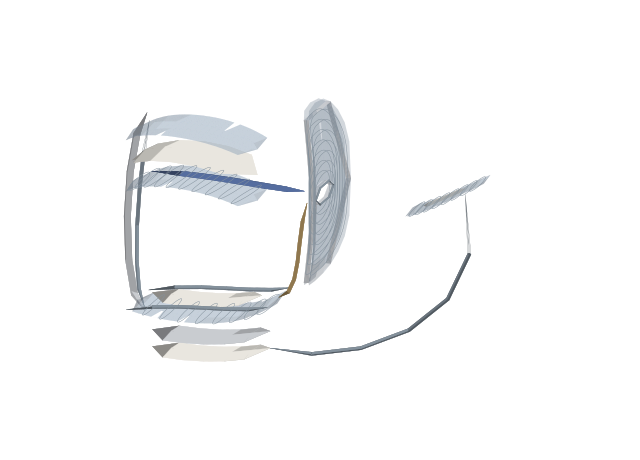
All parts
- Bound source strata preserve one immutable source closure. Only the narrow selected strip becomes the proposed view.
- Fragment B is selected from the source and stops at the only admission boundary in the held pose.
- The selected synthetic policy checks this proposed view against the local record for its intended observer.
- The local ledger remains present in every state. Its observer-keyed contents participate in admission; an empty ledger is still an accounting instrument.
- The external destination is outside the admission plane. The external receiving surface retains the admitted view.
- The admissible comparison reserves review-014 locally before any outbound traversal. Held work has no transport reservation.
- Possible exposure remains accounted for when the response is unknown. It is not refunded by the absence of a reply.
- The same review-014 remains prepared, uncertain or reconciled. Its outcome is separate from its exposure accounting.
- The fixture retrieves the existing operation and receipt. This return relation is not a new outbound dispatch.
Connections
Source snapshot to Admission Only selected fragment B is proposed.
Prior exposure to Admission Observer-keyed retained exposure participates in admission.
Admission to Reservation Reserve review-014 before transport.
Admission to Observer Held work emits zero outbound signals.
Observer to Effect record Reconcile review-014 without a new dispatch.
Recover the decision in its own time.
An illustrative institutional question that needs both history and controlled model context.
Ask at the right time
An operations team asks why a prior commitment used an earlier policy. A temporal memory retrieves the claim valid at that point, with its evidence.
Preserve the disagreement
A newer document contradicts one part of the record. The answer retains the conflict and its source instead of merging both into an invented certainty.
Bring a bounded view into the workflow.
Only the source-bound context required for the task is proposed for disclosure. Admission considers the destination and what it has previously received.
Choose the model context
Only the source-bound context required for the task is proposed for disclosure. Admission considers the destination and what it has previously received.
Return responsibility
The result carries its source context and remaining uncertainty to the responsible person. Any external action follows a separate approval and recovery path.
Within the Naevum ecosystem.
Explore the system
The product page explains its specific mechanisms and operating scope.
Connected systemExplore the system
The product page explains its specific mechanisms and operating scope.
Connected systemExplore the system
The product page explains its specific mechanisms and operating scope.
Technical referenceFurther context
What could these mechanisms make possible for you?
Discuss institutional memory