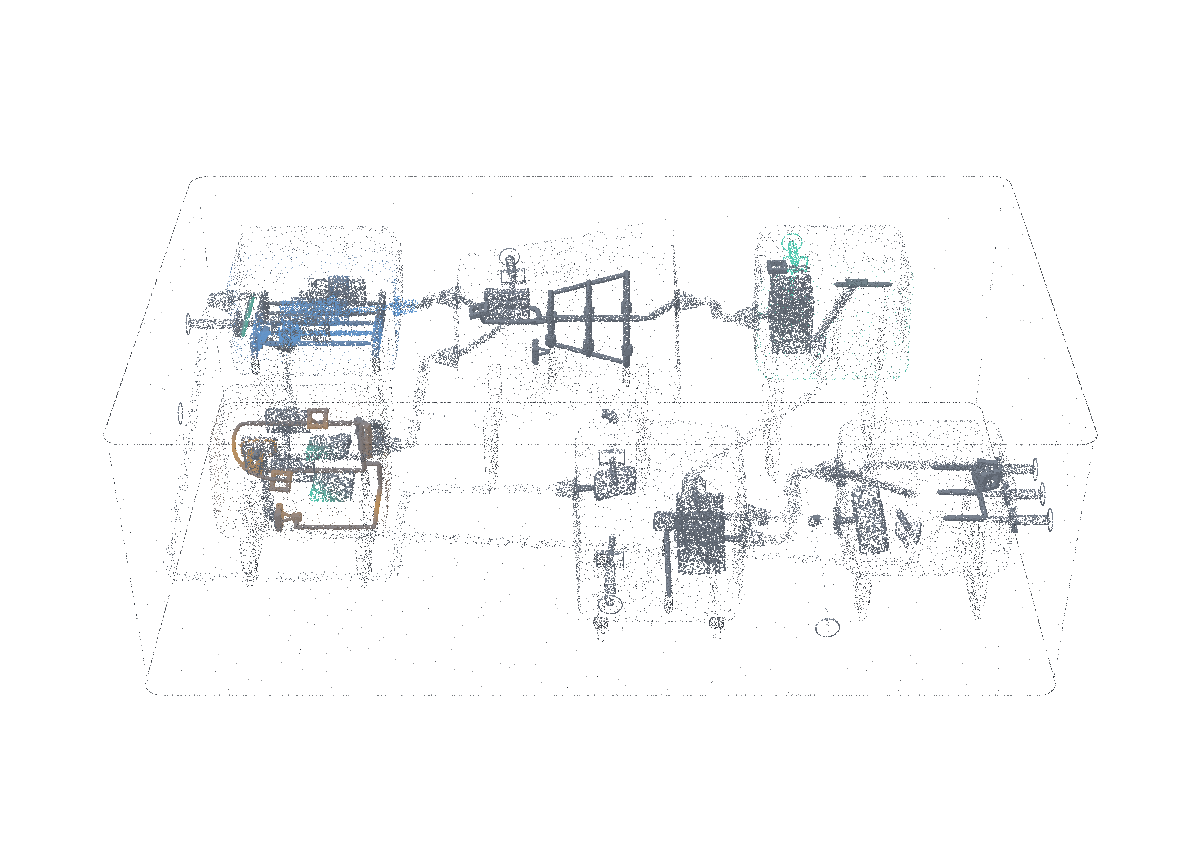
Extrasensory is a bio-inspired prediction system for fleet and plant engineers, so that they decide earlier whether to keep running, inspect or intervene, and know how sure the estimate is.
Bio-inspired system
Asset operators
Predictive maintenance
Calibrated risk
Loading model
Exposure and event-history reconstruction
Assemble eligible longitudinal history without turning incomplete observation into a failure event.
Inputs
Dated condition/exposure/event records and cutoff.
Eligible new evidence for a subsequent estimate, not a rewrite of the earlier record.
Transformation
Assemble eligible longitudinal history without turning incomplete observation into a failure event.
Retained state and outputs
Observation time, operating exposure and event identity.
Censoring, delayed entry, recurring/competing event context and evidence cutoff.
Constraints
Incomplete observation does not become a failure event; eligibility follows the declared cutoff.
Load, condition and sensing comparator
Distinguish a load-related response, persistent difference and unreliable sensing.
Inputs
Eligible channels and incompleteness.
Transformation
Distinguish a load-related response, persistent difference and unreliable sensing.
Retained state and outputs
Comparable operating regimes and source timing.
Competing explanations remain available.
Unreliable input holds interpretation and directs a sensing check.
Constraints
Unreliable sensing holds the interpretation and calls for an informative check.
Prior and local-evidence estimator
Combine an explicit class basis with eligible local evidence while retaining maturity and horizon.
Inputs
Longitudinal exposure and event history.
Aligned condition evidence, competing explanations and sensing limitations.
Class assumptions and provenance, including cold-start maturity.
Transformation
Combine an explicit class basis with eligible local evidence while retaining maturity and horizon.
Retained state and outputs
Class provenance and declared assumptions.
Local evidence contribution and sparse-history state.
A qualified time-to-event estimate; no invented mixture law or numeric life.
Constraints
Sparse local history retains its class assumptions and maturity; the illustration supplies no numerical remaining life.
Calibration and applicability
Carry calibration basis and applicability with the estimate rather than displaying an unconditional confidence score.
Inputs
Estimate, horizon and evidence/maturity record.
Declared grouped/finite-sample basis and applicability assumptions.
Transformation
Carry calibration basis and applicability with the estimate rather than displaying an unconditional confidence score.
Retained state and outputs
Grouped partition and finite-sample basis.
Target-population support or an explicit unresolved qualification.
Constraints
An estimate retains the limits of its calibration population and evidence.
Constrained decision workbench
Select useful monitoring, inspection or an intervention proposal from the actual unresolved question and constraints.
Inputs
The immutable forecast record.
Which competing explanation the next observation can resolve.
Criticality, operating limits and relevant consequences; no action authority.
Transformation
Select useful monitoring, inspection or an intervention proposal from the actual unresolved question and constraints.
Retained state and outputs
Criticality and operating consequences.
Monitoring, informative inspection and proposed intervention.
One selected real outlet; no equipment actuator.
Constraints
Monitoring, inspection and a proposed intervention are distinct choices. A choice does not operate equipment.
Forecast and prospective-outcome register
Freeze the estimate before the decision, then compare genuinely later independent evidence.
Inputs
Qualified uncertainty or explicit limitation to freeze before deciding.
Selected decision appended beside the earlier immutable forecast.
Independent later observation under the earlier forecast identity.
An independently supplied scored outcome when available.
Transformation
Freeze the estimate before the decision, then compare genuinely later independent evidence.
Retained state and outputs
Observation window, horizon, uncertainty and maturity are frozen before decision; the subsequent selected decision is appended separately.
Chosen decision appends beside the frozen estimate, never into its earlier forecast bytes.
Later observation and, when supplied, adjudication time.
Earlier forecast remains unchanged; later observation alone is not a scored outcome.
Constraints
Later evidence cannot rewrite the earlier forecast. A later reading alone does not establish a scored outcome.
Technical descriptionsInteractive model unavailable. The static illustration and descriptions remain available.
Exposure and event-history reconstruction
Assemble eligible longitudinal history without turning incomplete observation into a failure event.Technical data
Inputs
Dated condition/exposure/event records and cutoff.
Eligible new evidence for a subsequent estimate, not a rewrite of the earlier record.
Transformation
Assemble eligible longitudinal history without turning incomplete observation into a failure event.
Retained state and outputs
Observation time, operating exposure and event identity.
Censoring, delayed entry, recurring/competing event context and evidence cutoff.
Constraints
Incomplete observation does not become a failure event; eligibility follows the declared cutoff.
Load, condition and sensing comparator
Distinguish a load-related response, persistent difference and unreliable sensing.Technical data
Inputs
Eligible channels and incompleteness.
Transformation
Distinguish a load-related response, persistent difference and unreliable sensing.
Retained state and outputs
Comparable operating regimes and source timing.
Competing explanations remain available.
Unreliable input holds interpretation and directs a sensing check.
Constraints
Unreliable sensing holds the interpretation and calls for an informative check.
Prior and local-evidence estimator
Combine an explicit class basis with eligible local evidence while retaining maturity and horizon.Technical data
Inputs
Longitudinal exposure and event history.
Aligned condition evidence, competing explanations and sensing limitations.
Class assumptions and provenance, including cold-start maturity.
Transformation
Combine an explicit class basis with eligible local evidence while retaining maturity and horizon.
Retained state and outputs
Class provenance and declared assumptions.
Local evidence contribution and sparse-history state.
A qualified time-to-event estimate; no invented mixture law or numeric life.
Constraints
Sparse local history retains its class assumptions and maturity; the illustration supplies no numerical remaining life.
Calibration and applicability
Carry calibration basis and applicability with the estimate rather than displaying an unconditional confidence score.Technical data
Inputs
Estimate, horizon and evidence/maturity record.
Declared grouped/finite-sample basis and applicability assumptions.
Transformation
Carry calibration basis and applicability with the estimate rather than displaying an unconditional confidence score.
Retained state and outputs
Grouped partition and finite-sample basis.
Target-population support or an explicit unresolved qualification.
Constraints
An estimate retains the limits of its calibration population and evidence.
Constrained decision workbench
Select useful monitoring, inspection or an intervention proposal from the actual unresolved question and constraints.Technical data
Inputs
The immutable forecast record.
Which competing explanation the next observation can resolve.
Criticality, operating limits and relevant consequences; no action authority.
Transformation
Select useful monitoring, inspection or an intervention proposal from the actual unresolved question and constraints.
Retained state and outputs
Criticality and operating consequences.
Monitoring, informative inspection and proposed intervention.
One selected real outlet; no equipment actuator.
Constraints
Monitoring, inspection and a proposed intervention are distinct choices. A choice does not operate equipment.
Forecast and prospective-outcome register
Freeze the estimate before the decision, then compare genuinely later independent evidence.Technical data
Inputs
Qualified uncertainty or explicit limitation to freeze before deciding.
Selected decision appended beside the earlier immutable forecast.
Independent later observation under the earlier forecast identity.
An independently supplied scored outcome when available.
Transformation
Freeze the estimate before the decision, then compare genuinely later independent evidence.
Retained state and outputs
Observation window, horizon, uncertainty and maturity are frozen before decision; the subsequent selected decision is appended separately.
Chosen decision appends beside the frozen estimate, never into its earlier forecast bytes.
Later observation and, when supplied, adjudication time.
Earlier forecast remains unchanged; later observation alone is not a scored outcome.
Constraints
Later evidence cannot rewrite the earlier forecast. A later reading alone does not establish a scored outcome.
An illustrative equipment decision-support process.
Reconstructed history and current condition inform a qualified estimate. A prospective record preserves that estimate before the decision, so later evidence can be compared with what was known.
Reconstruct dated events and operating exposure, distinguishing condition changes from load and unreliable sensing.
Combine class assumptions with eligible local evidence. Carry the calibration basis, applicability and forecast horizon with the estimate.
Use the retained estimate and operating constraints to choose monitoring, inspection or an intervention proposal. Compare independent later evidence with the original forecast.
Revenue the largest companies lose to unplanned downtime, Siemens' indicative estimate
Siemens built this indicative estimate from interviews at large plants, and it puts unplanned downtime among the largest operating costs a company carries. The loss accrues between a weak signal and a late response, so Extrasensory gives the engineer a risk estimate with its uncertainty while there is still time to choose.
Keep operating. Inspect. Intervene.
In an illustrative asset history, a condition signal rises while the operating load also changes. The useful question is which response the evidence supports.
Keep operating
Check whether the signal is explained by load and whether the observation is current. An unchanged schedule is not evidence of unchanged risk.
Inspect
Choose an observation that can reduce the uncertainty relevant to the decision.
Intervene
Compare the proposed action with operating constraints, its consequences and the responsible person’s authority.
The history contains more than failures.
Operating duration, changing condition and incomplete observations all affect how a forecast should be interpreted.
Longitudinal histories include assets that remain in service and records that end before a failure is observed. Those censored observations matter. Sparse histories may begin with class priors whose assumptions remain visible.
Condition and load can adjust the estimate, while uncertainty and applicability travel with it. A confidence score needs a calibration study before it can be read as a coverage guarantee. An idle asset does not automatically become a repaired asset.
Choose the intervention window before the threshold
The fleet engineer chooses when and how to intervene; the model supplies the risk and how sure it is. Illustrative.
1 of 4A weak temperature drift appears in Vessel A's main engine at comparable load.
2 of 4The survival model updates the failure risk and draws its uncertainty band around the estimate.
3 of 4An intervention window opens before the threshold, showing what acting early costs at each point.
4 of 4The fleet engineer schedules an inspection at the next port call; the outcome trains the next estimate.Decision: The fleet engineer chooses when to intervene.
Select any part of the drawingScroll to step · Esc to skipFig. 1
1 of 4A pump at Plant 2 runs warmer while its load also rises.
2 of 4The model separates the load effect from the condition change and shows the part that stays unexplained.
3 of 4The window opens, and the engineer weighs a reading at comparable load against a planned stop.
4 of 4The engineer orders the comparable-load check first, and the estimate and the choice are stored before the outcome.Decision: The engineer chooses a check before a stop.
Select any part of the drawingScroll to step · Esc to skipFig. 1
1 of 4A sensor reports a jump that the asset's operating history cannot explain.
2 of 4The model widens its uncertainty band, because one unexplained reading says little about wear.
3 of 4The engineer checks the sensing path first and finds a failing sensor.Decision: The engineer decides to test the sensor before the machine.
4 of 4The false alarm is recorded with its cause, so the next estimate learns from it.
Select any part of the drawingScroll to step · Esc to skipFig. 1
Inside the mechanism. A warmer pump. What changed with it?
Illustrative equipment case: a pump’s reported operating temperature rises while its operating load also changes. This is a decision workflow, not a fault diagnosis or a measured remaining-life estimate.
The observation has two competing explanations.
The temperature change may track the changed load, or it may remain unexplained at comparable conditions. Preserve the load, sensor history and observation time before choosing an intervention.
Asset
A synthetic industrial pump.
Observed change
A rising reported operating-temperature trend while load changes.
Competing explanations
A load-related response or a persistent condition that the current context does not explain.
Current decision
Obtain a comparable-load observation and check the sensing path before inferring a fault.
The next observation changes the inspection decision.
Compare an aligned reading under an equivalent operating load, within the operator’s safe procedure. Check the sensor and operating context rather than treating a trend alone as a diagnosis.
If the difference resolves
Continue the agreed monitoring path and retain the explanation with its evidence.
If the difference persists
Escalate for the operator’s equipment inspection and intervention decision.
If the reading is unreliable
Investigate the sensing path; do not convert missing evidence into a healthy condition.
Later evaluation
Keep the earlier estimate, inspection and observed outcome separate for prospective evaluation.
Where it changes the work.
Illustrative situations, connected to the mechanisms that make them possible.
Follow condition on an operating vessel
Marine engineering
Load, condition and sensor histories change while equipment remains in service.
How it works
Exposure-aware diagnostics and time-to-event estimates connect the condition record to risk.
What changes
The engineering team can investigate how operating context changes the evidence behind an assessment.
Start with a sparse failure history
Industrial operators
An asset has limited local failure data but belongs to an understood equipment class.
How it works
Class priors and condition adjustments form an explicit cold-start basis.
What changes
The operator can inspect what the estimate inherits and what the local observations contribute.
Compare the next useful intervention
Asset-intensive organizations
Inspection, continued operation and maintenance carry different practical constraints.
How it works
Criticality and uncertainty inform a bounded comparison of available interventions.
What changes
The decision can retain its assumptions and be revisited when subsequent evidence arrives.
Scroll to explore · Esc to skip
Follow the forecast into the later outcome.
Predictive operations need a record of what was known before the decision.
Record the forecast
Retain the observation window, horizon, uncertainty and model maturity.
Record the intervention
Distinguish a proposed action, an approved action and an applied action.
Evaluate prospectively
Examine false alarms, lead time, calibration and adjudicated outcomes. Avoided downtime needs a defensible comparison.
Questions about Extrasensory.
Does a forecast automatically control equipment?
Prediction and intervention are separate. An engagement defines the decision workflow, permitted actions, operators and integration with the actual process.
How much history is needed?
That depends on the asset class, data quality and question. Discovery establishes what can be estimated from existing evidence, which priors are needed and what must be measured next.
Technical reference5 mechanisms · 1 further section
The mechanisms underneath.
The technical choices that give Extrasensory its particular behavior.
Time-to-event reasoning
Longitudinal histories distinguish censored observations, delayed entry, competing events and recurrent events. A common leakage policy governs which evidence is eligible for a prediction.
Condition-adjusted cold starts
Class-level priors and operating condition inform risk when local failure history is sparse. Inferred failure risk remains distinct from a scheduled maintenance countdown.
Load and condition are different signals
Multichannel diagnostics and load normalization distinguish changing operating regime from evidence of deterioration. Input alignment and exposure are part of the model’s meaning.
Calibration with explicit assumptions
Grouped partitions and finite-sample conformal ranks retain the basis of uncertainty estimates. Coverage and calibration are evaluated for the actual data and target population.
Prediction leads to a constrained choice
Criticality and operating context shape the comparison between observation, inspection and intervention. Subsequent evidence can update a bounded model without silently rewriting its decision limits.
Keep operating. Inspect. Intervene.
Extrasensory connects operating histories and changing conditions to risk, uncertainty and intervention decisions. Its predictive approach carries the evidence basis and decision constraints into the response.
Keep operating. Check whether the signal is explained by load and whether the observation is current. An unchanged schedule is not evidence of unchanged risk.
Inspect. Choose an observation that can reduce the uncertainty relevant to the decision.
Intervene. Compare the proposed action with operating constraints, its consequences and the responsible person’s authority.
Extrasensory in operation.
The predictive-preventive engine has been running for months in a pilot installation, learning from live operating data. Each new application has its own integration, data and acceptance.