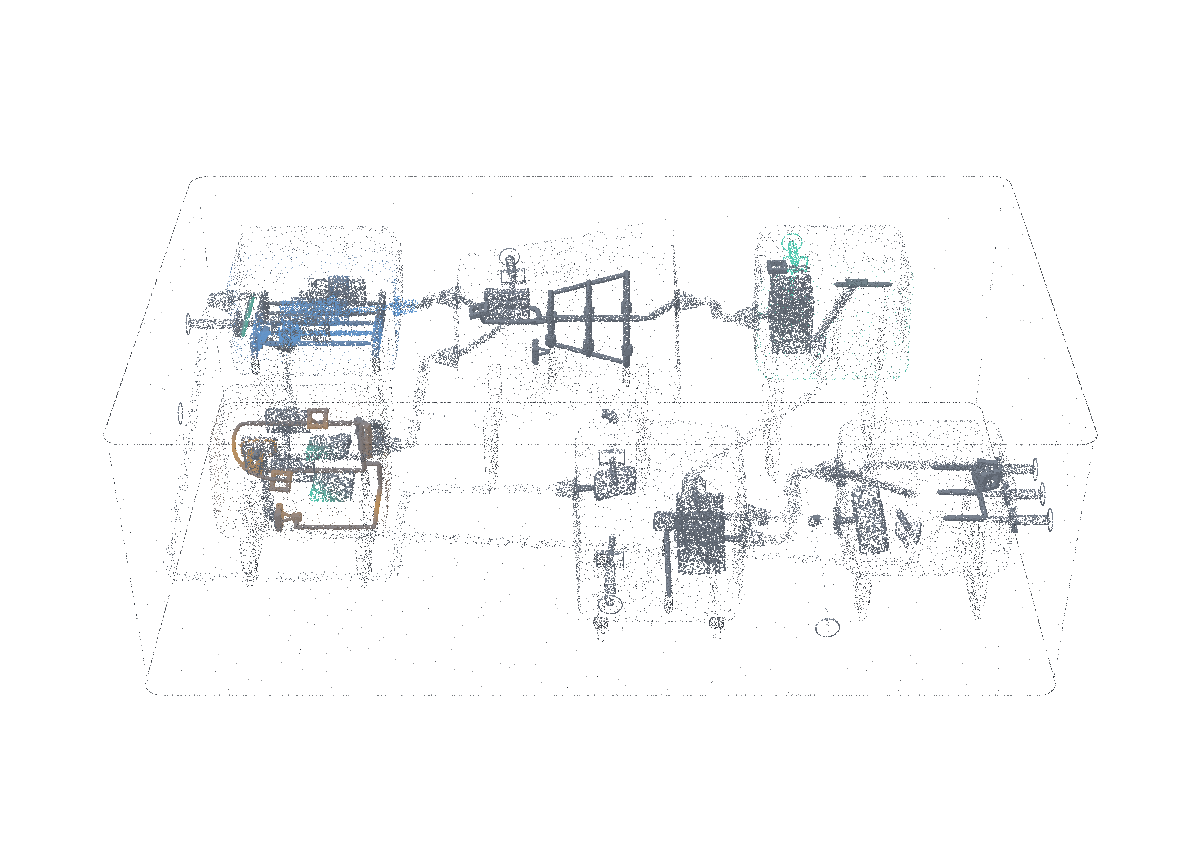
A rising signal creates a decision before it creates an incident.
Loading model
Exposure and event-history reconstruction
Assemble eligible longitudinal history without turning incomplete observation into a failure event.
Inputs
Dated condition/exposure/event records and cutoff.
Eligible new evidence for a subsequent estimate, not a rewrite of the earlier record.
Transformation
Assemble eligible longitudinal history without turning incomplete observation into a failure event.
Retained state and outputs
Observation time, operating exposure and event identity.
Censoring, delayed entry, recurring/competing event context and evidence cutoff.
Constraints
Incomplete observation does not become a failure event; eligibility follows the declared cutoff.
Load, condition and sensing comparator
Distinguish a load-related response, persistent difference and unreliable sensing.
Inputs
Eligible channels and incompleteness.
Transformation
Distinguish a load-related response, persistent difference and unreliable sensing.
Retained state and outputs
Comparable operating regimes and source timing.
Competing explanations remain available.
Unreliable input holds interpretation and directs a sensing check.
Constraints
Unreliable sensing holds the interpretation and calls for an informative check.
Prior and local-evidence estimator
Combine an explicit class basis with eligible local evidence while retaining maturity and horizon.
Inputs
Longitudinal exposure and event history.
Aligned condition evidence, competing explanations and sensing limitations.
Class assumptions and provenance, including cold-start maturity.
Transformation
Combine an explicit class basis with eligible local evidence while retaining maturity and horizon.
Retained state and outputs
Class provenance and declared assumptions.
Local evidence contribution and sparse-history state.
A qualified time-to-event estimate; no invented mixture law or numeric life.
Constraints
Sparse local history retains its class assumptions and maturity; the illustration supplies no numerical remaining life.
Calibration and applicability
Carry calibration basis and applicability with the estimate rather than displaying an unconditional confidence score.
Inputs
Estimate, horizon and evidence/maturity record.
Declared grouped/finite-sample basis and applicability assumptions.
Transformation
Carry calibration basis and applicability with the estimate rather than displaying an unconditional confidence score.
Retained state and outputs
Grouped partition and finite-sample basis.
Target-population support or an explicit unresolved qualification.
Constraints
An estimate retains the limits of its calibration population and evidence.
Constrained decision workbench
Select useful monitoring, inspection or an intervention proposal from the actual unresolved question and constraints.
Inputs
The immutable forecast record.
Which competing explanation the next observation can resolve.
Criticality, operating limits and relevant consequences; no action authority.
Transformation
Select useful monitoring, inspection or an intervention proposal from the actual unresolved question and constraints.
Retained state and outputs
Criticality and operating consequences.
Monitoring, informative inspection and proposed intervention.
One selected real outlet; no equipment actuator.
Constraints
Monitoring, inspection and a proposed intervention are distinct choices. A choice does not operate equipment.
Forecast and prospective-outcome register
Freeze the estimate before the decision, then compare genuinely later independent evidence.
Inputs
Qualified uncertainty or explicit limitation to freeze before deciding.
Selected decision appended beside the earlier immutable forecast.
Independent later observation under the earlier forecast identity.
An independently supplied scored outcome when available.
Transformation
Freeze the estimate before the decision, then compare genuinely later independent evidence.
Retained state and outputs
Observation window, horizon, uncertainty and maturity are frozen before decision; the subsequent selected decision is appended separately.
Chosen decision appends beside the frozen estimate, never into its earlier forecast bytes.
Later observation and, when supplied, adjudication time.
Earlier forecast remains unchanged; later observation alone is not a scored outcome.
Constraints
Later evidence cannot rewrite the earlier forecast. A later reading alone does not establish a scored outcome.
Technical descriptionsInteractive model unavailable. The static illustration and descriptions remain available.
Exposure and event-history reconstruction
Assemble eligible longitudinal history without turning incomplete observation into a failure event.Technical data
Inputs
Dated condition/exposure/event records and cutoff.
Eligible new evidence for a subsequent estimate, not a rewrite of the earlier record.
Transformation
Assemble eligible longitudinal history without turning incomplete observation into a failure event.
Retained state and outputs
Observation time, operating exposure and event identity.
Censoring, delayed entry, recurring/competing event context and evidence cutoff.
Constraints
Incomplete observation does not become a failure event; eligibility follows the declared cutoff.
Load, condition and sensing comparator
Distinguish a load-related response, persistent difference and unreliable sensing.Technical data
Inputs
Eligible channels and incompleteness.
Transformation
Distinguish a load-related response, persistent difference and unreliable sensing.
Retained state and outputs
Comparable operating regimes and source timing.
Competing explanations remain available.
Unreliable input holds interpretation and directs a sensing check.
Constraints
Unreliable sensing holds the interpretation and calls for an informative check.
Prior and local-evidence estimator
Combine an explicit class basis with eligible local evidence while retaining maturity and horizon.Technical data
Inputs
Longitudinal exposure and event history.
Aligned condition evidence, competing explanations and sensing limitations.
Class assumptions and provenance, including cold-start maturity.
Transformation
Combine an explicit class basis with eligible local evidence while retaining maturity and horizon.
Retained state and outputs
Class provenance and declared assumptions.
Local evidence contribution and sparse-history state.
A qualified time-to-event estimate; no invented mixture law or numeric life.
Constraints
Sparse local history retains its class assumptions and maturity; the illustration supplies no numerical remaining life.
Calibration and applicability
Carry calibration basis and applicability with the estimate rather than displaying an unconditional confidence score.Technical data
Inputs
Estimate, horizon and evidence/maturity record.
Declared grouped/finite-sample basis and applicability assumptions.
Transformation
Carry calibration basis and applicability with the estimate rather than displaying an unconditional confidence score.
Retained state and outputs
Grouped partition and finite-sample basis.
Target-population support or an explicit unresolved qualification.
Constraints
An estimate retains the limits of its calibration population and evidence.
Constrained decision workbench
Select useful monitoring, inspection or an intervention proposal from the actual unresolved question and constraints.Technical data
Inputs
The immutable forecast record.
Which competing explanation the next observation can resolve.
Criticality, operating limits and relevant consequences; no action authority.
Transformation
Select useful monitoring, inspection or an intervention proposal from the actual unresolved question and constraints.
Retained state and outputs
Criticality and operating consequences.
Monitoring, informative inspection and proposed intervention.
One selected real outlet; no equipment actuator.
Constraints
Monitoring, inspection and a proposed intervention are distinct choices. A choice does not operate equipment.
Forecast and prospective-outcome register
Freeze the estimate before the decision, then compare genuinely later independent evidence.Technical data
Inputs
Qualified uncertainty or explicit limitation to freeze before deciding.
Selected decision appended beside the earlier immutable forecast.
Independent later observation under the earlier forecast identity.
An independently supplied scored outcome when available.
Transformation
Freeze the estimate before the decision, then compare genuinely later independent evidence.
Retained state and outputs
Observation window, horizon, uncertainty and maturity are frozen before decision; the subsequent selected decision is appended separately.
Chosen decision appends beside the frozen estimate, never into its earlier forecast bytes.
Later observation and, when supplied, adjudication time.
Earlier forecast remains unchanged; later observation alone is not a scored outcome.
Constraints
Later evidence cannot rewrite the earlier forecast. A later reading alone does not establish a scored outcome.
An illustrative equipment decision-support process.
Interpret the changing condition.
A synthetic asset scenario illustrating predictive operations; no avoided failure is claimed.
Read the history
A condition signal has increased. The operating history also shows a change in load, so the signal needs interpretation in context.
Ask what is known
The estimate retains its evidence basis, forecast horizon and uncertainty. Sparse observations may require a class prior rather than a fitted asset-specific model.
Choose a response, then examine the outcome.
The operator compares continued operation, an inspection and an intervention. The most useful next step may be the one that resolves a decision-critical unknown.
Choose the next observation
The operator compares continued operation, an inspection and an intervention. The most useful next step may be the one that resolves a decision-critical unknown.
Evaluate later
The record separates forecast, proposed response and applied action. Later evaluation examines calibration, false alarms and the actual outcome against a declared comparison.