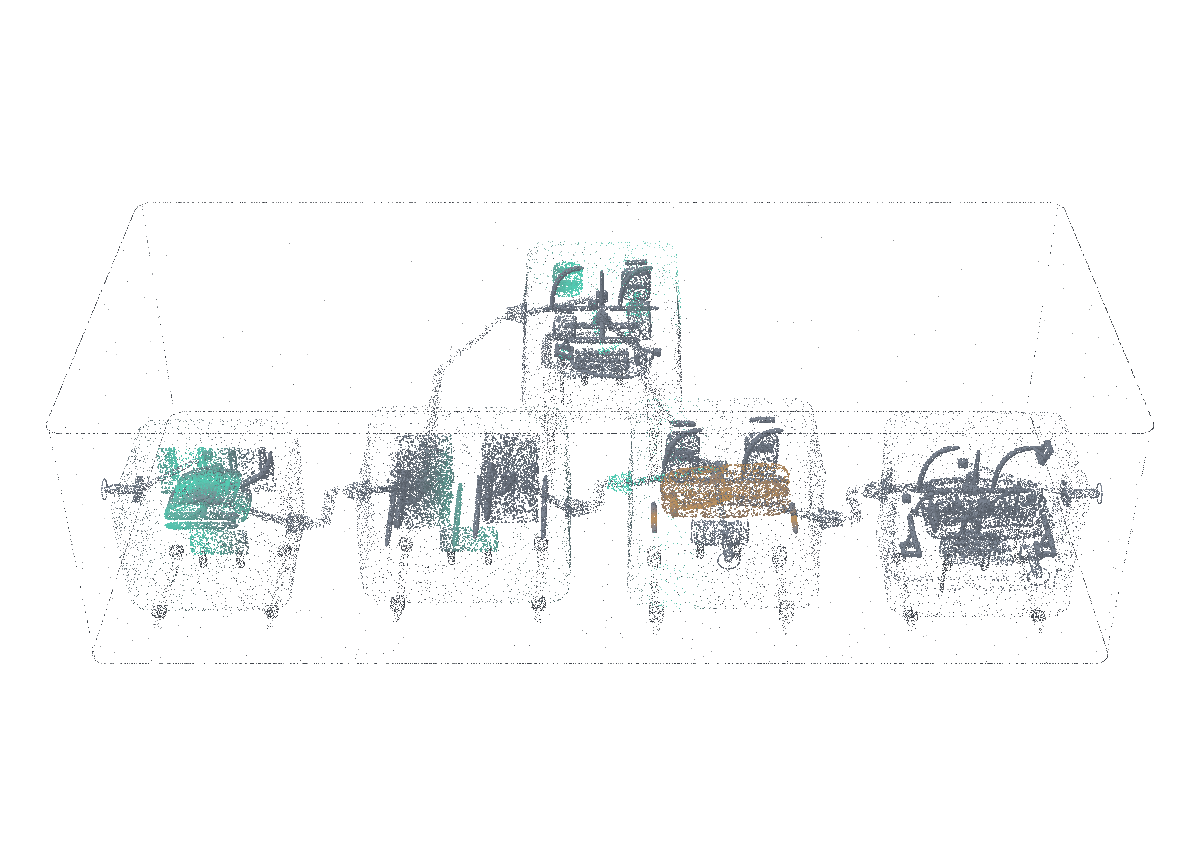
The Vault is a method and component atlas for heads of engineering, so that a team reusing a mechanism inherits its assumptions and turns each open one into a test.
Foundation
R&D teams
Reusable methods
Evidence grading
Loading model
Question and research trace
Retain the question, relevant prior work and explicit negative search results.
Inputs
Proposed reuse and intended environment.
Transformation
Retain the question, relevant prior work and explicit negative search results.
Retained state and outputs
Claim and intended environment.
References, counterexamples and failed searches.
Constraints
Negative searches and counterexamples remain part of the research record.
Component and method register
Discover typed candidates while distinguishing capability from working method.
Inputs
Source-connected component/method candidates.
Transformation
Discover typed candidates while distinguishing capability from working method.
Retained state and outputs
Mechanism identity, ports and contracts.
Workflow identity, evidence and lineage.
Constraints
A capability entry and a working method are different kinds of evidence.
Evidence and falsifier bench
Grade the specific claim and test whether the proposed verification can fail.
Inputs
Specific claim, artifacts and existing evidence.
Actual harness/canary or reproduction result.
Actual result, including failure/refutation.
Transformation
Grade the specific claim and test whether the proposed verification can fail.
Research traces lead to typed components and working methods. Evidence and falsifiers inform composition, while unmet assumptions remain obligations for a target experiment.
Connect a question to scientific references, prior work and explicit search results.
Keep evidence grades, counterexamples and negative controls with the mechanism.
Compare interfaces, timing and environmental assumptions before combining methods and components. Carry unresolved obligations into the target experiment with their evidence.
A team wants to combine a temporal memory component with a workflow. Matching function signatures is only the beginning.
The Vault connects components, methods, contracts, evidence and lineage. A component describes a mechanism. A method describes how work is performed. Both need enough context for another team to decide whether reuse is justified.
Negative findings belong beside successful candidates. A failed experiment can save another team from accepting an assumption that did not survive testing.
A connection can carry an unfinished obligation.
Typed ports describe interface compatibility; assume/guarantee contracts describe the environment that the component needs.
Inspect the interface
Check what a port accepts and produces, including cadence, absence and ordering where relevant.
Carry the assumption
A composition preserves obligations its parts have not discharged. Connecting two APIs cannot erase those requirements.
Turn the gap into a test
An unresolved timing or delivery assumption becomes a specific experiment against the intended environment.
Reuse a component, with its assumptions attached
The head of engineering decides whether to reuse; open assumptions become tests first. Illustrative.
1 of 5A team needs a scheduler that tolerates late sensor data, and its head of engineering asks the atlas first.
2 of 5The atlas matches a mechanism and hands over its contract with it.
3 of 5One assumption, about message order, is still unproven for this team's setting.
4 of 5The team turns that open assumption into a specific test against its real data.
5 of 5The head of engineering approves reuse once the test passes, and the result becomes evidence for the next team.Decision: The head of engineering approves the reuse.
Select any part of the drawingScroll to step · Esc to skipFig. 1
1 of 4An architect finds two components that fit by interface: a time-aware memory and a review workflow.
2 of 4Joining them carries an obligation neither meets alone: who handles a record with no timestamp.
3 of 4The team writes that obligation as an integration test in the target environment.
4 of 4The architect ships the composition only after the test passes.Decision: The architect decides when the composition ships.
Select any part of the drawingScroll to step · Esc to skipFig. 1
1 of 4A team proposes reusing a forecasting method from another project.
2 of 4The method's record shows it was built on a premise of steady load.
3 of 4A test against the team's variable load fails.
4 of 4The head of engineering rejects the reuse, and the failed test stays in the atlas for the next team to see.Decision: The head of engineering rejects the reuse.
Select any part of the drawingScroll to step · Esc to skipFig. 1
What the research says
Reuse is a claim until someone can check it
Research on judgment and on logging points the same way: a written rule and a small proof outperform memory and impression. The Vault gives each reusable mechanism its assumptions and test results, so a head of engineering checks them before a promising demo becomes a dependency.
Inside the mechanism. Two compatible types can still leave an obligation.
Illustrative scenario. A sensor component and a controller agree on units but disagree about timing.
The output type fits. The cadence does not.
A typed connection alone cannot establish that a controller receives sufficiently fresh observations.
Producer guarantee
Emit a temperature observation at its declared cadence.
Consumer assumption
Receive an observation within a shorter freshness window.
Unresolved obligation
The composition must account for delayed or missing input.
Decision
Keep compatibility unresolved rather than declaring the connection accepted.
An explicit adapter changes what the consumer can rely on.
The proposed assembly documents stale-state behavior and the remaining assumptions before target acceptance.
Adapter
Expose observation age and an explicit absent state.
Consumer change
Hold action when the freshness condition is not met.
Propagated assumption
The target operator supplies the agreed sensing cadence.
Acceptance
Test absence and delayed-input behavior in the intended target.
Where it changes the work.
Illustrative situations, connected to the mechanisms that make them possible.
Find the mechanism before building again
R&D and software teams
A new problem may overlap earlier engineering in another project.
How it works
Typed component and method registers retain contracts, scientific references and lineage.
What changes
The team can inspect a candidate and the evidence behind its reuse.
Challenge an invention early
Research organizations
A plausible idea may reproduce known prior art or fail under a simple counterexample.
How it works
Prior-art search, negative controls and evidence grades stay attached to the technical claim.
What changes
Research effort can move toward a discriminating experiment before the idea becomes a product promise.
Carry knowledge between projects
Institutions
A useful engineering result should survive its original author and project.
How it works
The selected method retains inputs, contract, limitations and its experimental record.
What changes
A later team receives a technical argument it can inspect and reproduce.
Scroll to explore · Esc to skip
The next use is part of the evidence.
A catalog entry becomes more useful when another system can reproduce its effect and adopt it under stated conditions.
Recurring mechanisms across independently developed systems can suggest candidates for reuse. Their novelty, assumption independence and downstream value remain questions to examine.
Research, an accepted component and a patent have different evidential and legal meanings. Public examples use cleared material, and adoption is described only where an actual downstream use can be identified.
Questions about The Vault.
Is the Vault a document archive?
Documents support it, but its organizing units are mechanisms, methods, contracts and evidence. The goal is to make engineering knowledge usable in another system.
What can a research engagement deliver?
A technical question, source-backed alternatives, a falsifiable experiment, a reusable artifact with its contract, and an adoption decision grounded in the result.
Technical reference5 mechanisms · 2 further sections
The mechanisms underneath.
The technical choices that give The Vault its particular behavior.
Scientific evidence travels with the method
A mechanism retains its scientific references or the explicit search that found none. Failed searches, counterexamples and refutations remain useful research outcomes.
Components and methods are different registers
One register describes what a system does; another describes how work is performed. Typed identities, contracts and lineage connect candidates without confusing a workflow with executable capability.
Evidence has a promotion ladder
Assertion, available artifact, functional evidence, independent reproduction and replication carry different grades. A negative control tests that the proposed verification can actually fail.
Composition preserves the argument
Candidate discovery, compatibility checks and discriminating experiments connect a question to a reusable result. The reason a component was selected remains available to the next project.
Invention is a technical claim
Mechanism, technical effect, prior art and a deliberate disclosure decision form the invention path. Candidate claims, filed applications and granted rights remain distinct records.
What can we reuse, and what must still be proved?
The Vault organizes reusable engineering as components, methods, contracts and evidence. Composition carries unresolved assumptions into the assembled system, where a test can determine whether reuse is justified.
A connection can carry an unfinished obligation.
Inspect the interface. Check what a port accepts and produces, including cadence, absence and ordering where relevant.
Carry the assumption. A composition preserves obligations its parts have not discharged. Connecting two APIs cannot erase those requirements.
Turn the gap into a test. An unresolved timing or delivery assumption becomes a specific experiment against the intended environment.