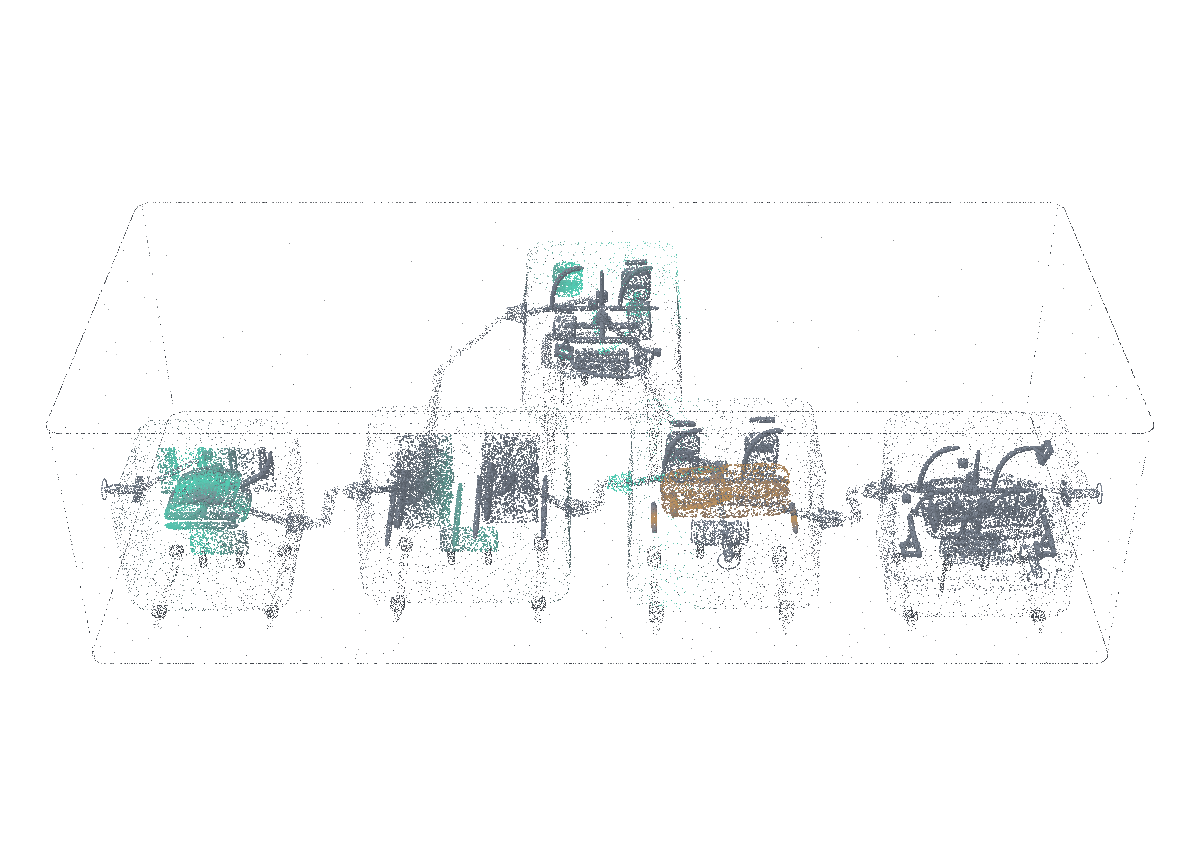
From a research question to a technical invention A promising component arrives with a question attached.
Loading model
An illustrative process for investigating claims, comparing contracts and retaining unresolved obligations.
Question and research trace Retain the question, relevant prior work and explicit negative search results.
Inputs Proposed reuse and intended environment.
Transformation Retain the question, relevant prior work and explicit negative search results.
Retained state and outputs Claim and intended environment.
References, counterexamples and failed searches.
Constraints Negative searches and counterexamples remain part of the research record.
Component and method register Discover typed candidates while distinguishing capability from working method.
Inputs Source-connected component/method candidates.
Transformation Discover typed candidates while distinguishing capability from working method.
Retained state and outputs Mechanism identity, ports and contracts.
Workflow identity, evidence and lineage.
Constraints A capability entry and a working method are different kinds of evidence.
Evidence and falsifier bench Grade the specific claim and test whether the proposed verification can fail.
Inputs Specific claim, artifacts and existing evidence.
Actual harness/canary or reproduction result.
Actual result, including failure/refutation.
Transformation Grade the specific claim and test whether the proposed verification can fail.
Retained state and outputs Assertion/artifact/function/reproduction/replication remain distinct.
Refutations remain useful retained records.
Constraints A proposed verification must be able to expose a failure.
Composition and obligation bench Compare typed interfaces, QoS and environmental assumptions.
Inputs Producer guarantees and consumer assumptions.
Evidence grade and refutations, not automatic compatibility.
Explicit age/absence behavior and remaining environment obligation.
Transformation Compare typed interfaces, QoS and environmental assumptions.
Retained state and outputs Type, cadence, absence and ordering.
Undischarged assumptions remain attached to the assembly.
Constraints Type compatibility alone does not discharge timing, ordering or environment assumptions.
Target experiment and adoption Test the gap in the intended setting and retain the actual result for reuse.
Inputs A concrete gap to test in the target.
Independent behavior under the intended delayed/absent-input case.
Transformation Test the gap in the intended setting and retain the actual result for reuse.
Retained state and outputs Delayed/absent inputs and intended conditions.
Actual outcome and identified downstream use where available.
Constraints A target-setting evaluation is evidence for that setting; it is not general proof.
Technical descriptionsInteractive model unavailable. The static illustration and descriptions remain available. Question and research trace Retain the question, relevant prior work and explicit negative search results. Technical data Inputs Proposed reuse and intended environment.
Transformation Retain the question, relevant prior work and explicit negative search results.
Retained state and outputs Claim and intended environment.
References, counterexamples and failed searches.
Constraints Negative searches and counterexamples remain part of the research record.
Component and method register Discover typed candidates while distinguishing capability from working method. Technical data Inputs Source-connected component/method candidates.
Transformation Discover typed candidates while distinguishing capability from working method.
Retained state and outputs Mechanism identity, ports and contracts.
Workflow identity, evidence and lineage.
Constraints A capability entry and a working method are different kinds of evidence.
Evidence and falsifier bench Grade the specific claim and test whether the proposed verification can fail. Technical data Inputs Specific claim, artifacts and existing evidence.
Actual harness/canary or reproduction result.
Actual result, including failure/refutation.
Transformation Grade the specific claim and test whether the proposed verification can fail.
Retained state and outputs Assertion/artifact/function/reproduction/replication remain distinct.
Refutations remain useful retained records.
Constraints A proposed verification must be able to expose a failure.
Composition and obligation bench Compare typed interfaces, QoS and environmental assumptions. Technical data Inputs Producer guarantees and consumer assumptions.
Evidence grade and refutations, not automatic compatibility.
Explicit age/absence behavior and remaining environment obligation.
Transformation Compare typed interfaces, QoS and environmental assumptions.
Retained state and outputs Type, cadence, absence and ordering.
Undischarged assumptions remain attached to the assembly.
Constraints Type compatibility alone does not discharge timing, ordering or environment assumptions.
Target experiment and adoption Test the gap in the intended setting and retain the actual result for reuse. Technical data Inputs A concrete gap to test in the target.
Independent behavior under the intended delayed/absent-input case.
Transformation Test the gap in the intended setting and retain the actual result for reuse.
Retained state and outputs Delayed/absent inputs and intended conditions.
Actual outcome and identified downstream use where available.
Constraints A target-setting evaluation is evidence for that setting; it is not general proof.
An illustrative process for investigating claims, comparing contracts and retaining unresolved obligations.
Additional mechanisms are described in the technical reference .
Find the assumption the connection leaves open. An illustrative engineering investigation into whether two components can be composed.
Name the proposed effect A team expects a memory component to improve a workflow’s use of historical decisions. It states the task, baseline and failure condition before testing.
Inspect the assumptions Compatible ports still leave an unanswered requirement about update ordering. The composition carries that obligation into the assembled design.
Make the result useful to another system. A test introduces delayed and contradictory updates. The observed behavior determines whether the proposed combination preserves the intended decision history.
Run the discriminating experiment A test introduces delayed and contradictory updates. The observed behavior determines whether the proposed combination preserves the intended decision history.
Make the result reusable The artifact retains its contract, evidence and negative findings. A subsequent adoption tests whether the same effect survives in the receiving system.
Within the Naevum ecosystem. Technical reference Further context
What could these mechanisms make possible for you?
Discuss a technical question