Conductr is a coordination harness for engineering leaders whose coding agents share one repository, so that only work checked against tests the agent did not write reaches the main branch.
Foundation
Engineering teams
Coding-agent coordination
Verified changes
Loading model
Task and acceptance reference
Fix the experiment basis outside the worker success report.
Inputs
Fixed task, seed, oracle, budget and selected variation.
Transformation
Fix the experiment basis outside the worker success report.
Retained state and outputs
Task corpus, seed, budget and acceptance oracle.
Baseline and alternative differ only at the declared slot.
Constraints
The experiment basis and acceptance oracle remain independent of a worker success report.
Context and planning
Select relevant dependencies and form bounded work through explicit component contracts.
Inputs
Unchanged task and permitted context-slot replacement.
Selected source/dependencies.
Actual finding tied to the same task/source.
Transformation
Select relevant dependencies and form bounded work through explicit component contracts.
Retained state and outputs
Source selection and permitted replacement interface.
Plan and orchestration constraints.
Constraints
Only the declared component or input changes in the comparison.
Ordered execution
Carry work through the selected execution/routing interfaces.
Inputs
Bounded planned attempt under fixed orchestration.
Actual availability selects the declared degraded route.
Transformation
Carry work through the selected execution/routing interfaces.
Retained state and outputs
Candidate artifact and declared execution basis.
Component-specific unavailable/fallback behavior.
Constraints
Unavailable routes retain their declared degraded or fallback behavior.
Independent examination
Judge the identified artifact with distinct verification kinds.
Inputs
Identified artifact, not the worker success claim.
Independently defined acceptance.
Transformation
Judge the identified artifact with distinct verification kinds.
Retained state and outputs
Standing, structural and behavioral checks.
Declared coverage and unresolved findings.
Constraints
Structural, behavioral and standing checks answer different acceptance questions.
Experiment and continuation
Retain actual paired results, resource cost and the next decision.
Inputs
Observed check result and coverage basis.
Measured attempt cost/failure/completion.
Transformation
Retain actual paired results, resource cost and the next decision.
Retained state and outputs
Useful completion, failures and uncertainty.
Findings and applicable commit decision remain separate.
Constraints
An unmeasured comparison has no established winner.
Technical descriptionsInteractive model unavailable. The static illustration and descriptions remain available.
Task and acceptance reference
Fix the experiment basis outside the worker success report.Technical data
Inputs
Fixed task, seed, oracle, budget and selected variation.
Transformation
Fix the experiment basis outside the worker success report.
Retained state and outputs
Task corpus, seed, budget and acceptance oracle.
Baseline and alternative differ only at the declared slot.
Constraints
The experiment basis and acceptance oracle remain independent of a worker success report.
Context and planning
Select relevant dependencies and form bounded work through explicit component contracts.Technical data
Inputs
Unchanged task and permitted context-slot replacement.
Selected source/dependencies.
Actual finding tied to the same task/source.
Transformation
Select relevant dependencies and form bounded work through explicit component contracts.
Retained state and outputs
Source selection and permitted replacement interface.
Plan and orchestration constraints.
Constraints
Only the declared component or input changes in the comparison.
Ordered execution
Carry work through the selected execution/routing interfaces.Technical data
Inputs
Bounded planned attempt under fixed orchestration.
Actual availability selects the declared degraded route.
Transformation
Carry work through the selected execution/routing interfaces.
Retained state and outputs
Candidate artifact and declared execution basis.
Component-specific unavailable/fallback behavior.
Constraints
Unavailable routes retain their declared degraded or fallback behavior.
Independent examination
Judge the identified artifact with distinct verification kinds.Technical data
Inputs
Identified artifact, not the worker success claim.
Independently defined acceptance.
Transformation
Judge the identified artifact with distinct verification kinds.
Retained state and outputs
Standing, structural and behavioral checks.
Declared coverage and unresolved findings.
Constraints
Structural, behavioral and standing checks answer different acceptance questions.
Experiment and continuation
Retain actual paired results, resource cost and the next decision.Technical data
Inputs
Observed check result and coverage basis.
Measured attempt cost/failure/completion.
Transformation
Retain actual paired results, resource cost and the next decision.
Retained state and outputs
Useful completion, failures and uncertainty.
Findings and applicable commit decision remain separate.
Constraints
An unmeasured comparison has no established winner.
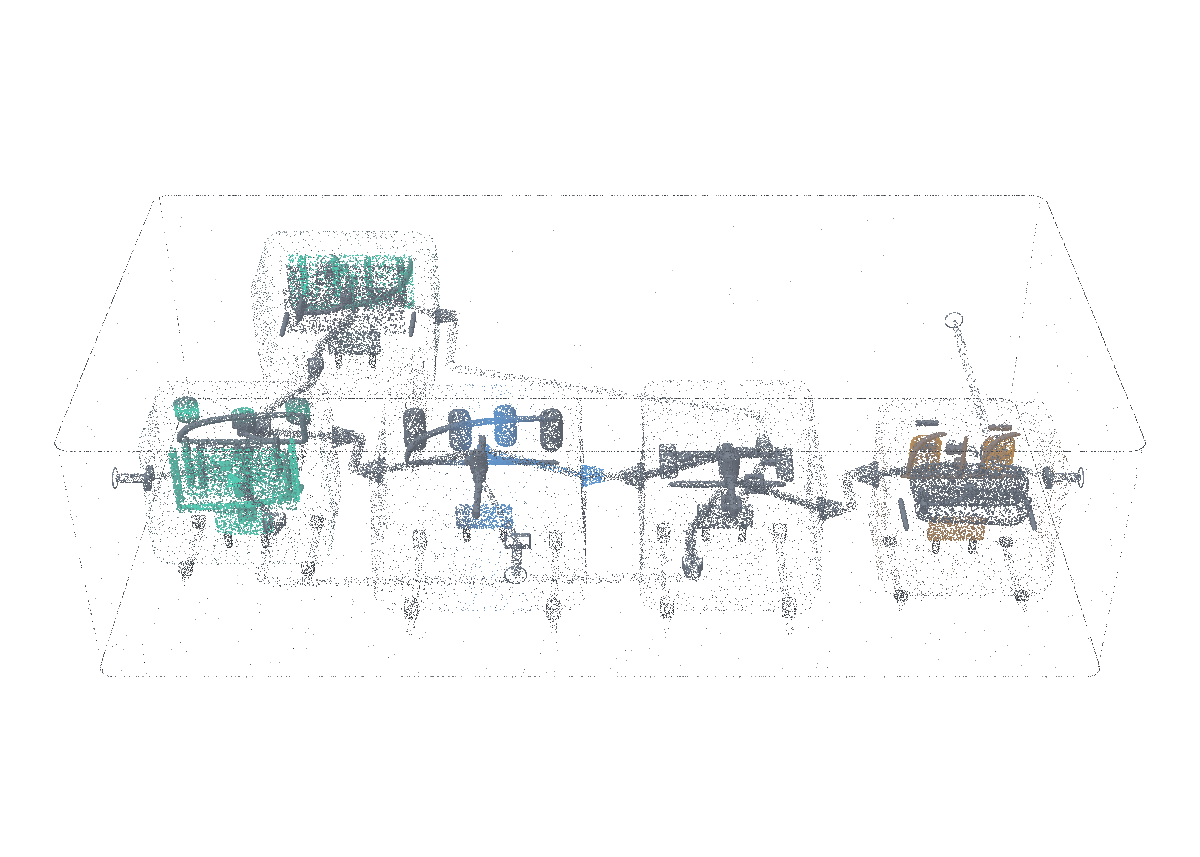
An illustrative work harness with a fixed task, oracle and retained findings.
A fixed task and acceptance reference guide context selection, execution and independent examination. Findings and measured costs remain connected to the next attempt.
Give the implementation attempt an explicit objective and operating context.
Compare the result with the intended change in a separate review step.
Retain specific findings and the next attempt’s context. Compare paired results and resource costs when the observations are available.
A team is changing its agent harness and needs to understand how the change affects the work. Context acquisition, execution and acceptance need to be examined separately from the agent’s own report of success.
Use Conductr to inspect an agent’s working process or compare a harness component on a declared task. Begin with the relevant source and an independently defined acceptance condition; keep the task and resource basis fixed when comparing attempts.
Acquire context
Select the source and dependencies relevant to the requested change.
Declare acceptance
Define the acceptance conditions outside the worker’s own success report.
Run and examine
A bounded attempt returns a change and verification evidence. The next decision follows the actual findings.
Inspect the harness one component at a time.
Change one component while keeping the task, seed, acceptance oracle and resource budget fixed.
Contract-defined slots cover context, planning, execution, sandboxing, routing, credentials, verification, policy, memory and measurement. The fixed orchestration order lets a team isolate a component’s contribution.
Independent test authority and a commit-boundary gate examine the artifact separately from the executor’s confidence. Standing, structural and behavioral checks retain their own scope; coverage needs a declared denominator.
Let several coding agents work on one repository
The CTO decides how work is split and who settles conflicts; the review gate decides what merges. Illustrative.
1 of 4The CTO splits the work into tasks, each naming its files, its forbidden changes and an acceptance test.Decision: The CTO decides how the work is split.
2 of 4Each agent works in its own harness, with only the context its task needs.
3 of 4The review gate runs tests the agents did not write against each change.
4 of 4Only changes that pass reach the main branch, each linked to its task and its test result.
Select any part of the drawingScroll to step · Esc to skipFig. 1
1 of 4Two agents edit the same configuration file for different tasks.
2 of 4The review gate finds that the second change breaks the first task's acceptance test.
3 of 4The engineering lead decides which task owns the file, and the other task is re-planned.Decision: The engineering lead settles which task owns the file.
4 of 4The re-planned change passes on a fresh attempt and joins the main branch.
Select any part of the drawingScroll to step · Esc to skipFig. 1
1 of 4The CTO approves trying a cheaper open model in place of the current agent's provider.Decision: The CTO approves the trial.
2 of 4The task, its acceptance test and its budget stay fixed, so the two agents face the same job.
3 of 4The review gate judges the new agent's change exactly as it judged the old one.
4 of 4The result tells the team whether the swap helped, for this task and this test, before anything merges.
Select any part of the drawingScroll to step · Esc to skipFig. 1
How often the busiest fifth of Microsoft 365 users are interrupted in core hours
Agents finish longer tasks each year, capable open models now run on a single workstation GPU, and the engineers reviewing their work are interrupted constantly. A team that lets several agents into one repository needs its checks outside the agent and outside anyone's memory, so Conductr gates every change on tests the agent did not write.
Inside the mechanism. Replace one component. Keep the experiment fixed.
Illustrative scenario. A harness change can be studied without changing the task or declaring an unsupported performance win.
Record the reference execution conditions.
An independent evaluation defines the unit of work and expected outcome before comparing alternatives.
Fixed inputs
Task corpus, seed, budget and acceptance oracle.
Selected component
The context assembly slot.
External check
Independent tests judge the work artifact.
Measurement
Useful completion, failures and resource cost.
A component change has a bounded comparison.
The alternate configuration runs under the same rules. Its observed outcome determines whether the change helps.
Change
Replace only the context component through its contract.
Preserve
The orchestration order and authority boundaries.
Compare
Report the actual paired results and uncertainty.
Commit boundary
A successful execution still passes the applicable commit gate.
Where it changes the work.
Illustrative situations, connected to the mechanisms that make them possible.
Understand an agent’s working behavior
Individual developers
An agent follows a process whose promises are otherwise difficult to inspect.
How it works
Observation hooks compare behavior with declared promises and retain telemetry.
What changes
The developer gains a concrete record for investigating recurring process failures.
Test a proposed harness improvement
AI engineering teams
A change appears promising but could weaken behavior elsewhere.
How it works
The offline measure harness compares it against a RED-baseline corpus.
What changes
The change has an explicit experiment rather than a success claim based on one attractive output.
Replace a component without a new harness
Developer-tool builders
Context, verification or routing needs a different implementation.
How it works
Interface-bounded components separate behavior from the assembly’s private policy and wiring.
What changes
A team can investigate one mechanism while preserving the responsibilities of the surrounding system.
Scroll to explore · Esc to skip
Evaluate a harness change as an experiment.
A paired experiment can hold the task and acceptance basis steady while changing one part of the development process.
The proving-ground direction makes costs, correctness and failure modes inspectable for a particular comparison. A containment integration is evaluated against the specific routes it is intended to control.
Discuss the integration you have in mind, and we will scope it with you.
A fallback is part of the component contract.
A harness must state what happens when an integration is unavailable or a component cannot complete its work.
The selected degradation behavior belongs to the specific integration and execution policy. An experiment exercises that degraded route alongside the successful path, keeping the task, oracle, seed and budget fixed.
A harness fallback is not automatically a privacy boundary. Conductr’s execution/degradation rules and Synapse’s context-admission rules have distinct responsibilities and evaluation cases.
Questions about Conductr.
Must Black Box run on Conductr?
Conductr contributes development-harness ideas and tooling. Black Box’s role and delivery architecture is a separate system; a mandatory runtime dependency is not asserted.
Can we use a different provider or verification component?
The component architecture defines those seams. A concrete integration must check provider capability, custody, acceptance and the behavior of the replacement.
Technical reference5 mechanisms · 2 further sections
The mechanisms underneath.
The technical choices that give Conductr its particular behavior.
Component slots with contracts
Context acquisition, planning, orchestration, execution, routing and verification have explicit roles in the harness.
Acceptance outside the author’s report
Externally authored acceptance conditions give verification a basis independent of a worker claiming success.
Several kinds of verification
Standing, structural and behavioral checks cover different questions. Coverage is assessed against a declared denominator.
Observation and steering
Telemetry and live-loop control are separate concerns. Advisory pacing can respond to the highest-risk area touched.
Paired harness experiments
A declared task and acceptance basis support comparison of a particular harness change. Optional containment keeps its actual scope.
Carry one change from context to verification.
Conductr is a component-based harness for AI-assisted development. Context, planning, execution, verification and human checkpoints have inspectable roles, with experiments for evaluating changes to the process.
Acquire context. Select the source and dependencies relevant to the requested change.
Declare acceptance. Define the acceptance conditions outside the worker’s own success report.
Run and examine. A bounded attempt returns a change and verification evidence. The next decision follows the actual findings.
Additional slots cover sandboxing, credential custody, human checkpoints and event or trust state. Explicit interfaces let a team examine a component’s contribution and consider replacements without losing the surrounding process.
Standing, structural and behavioral checks answer different questions. Coverage needs a declared denominator. Observation and live-loop steering stay distinct, and advisory pacing can respond to the highest-risk area touched by a change.