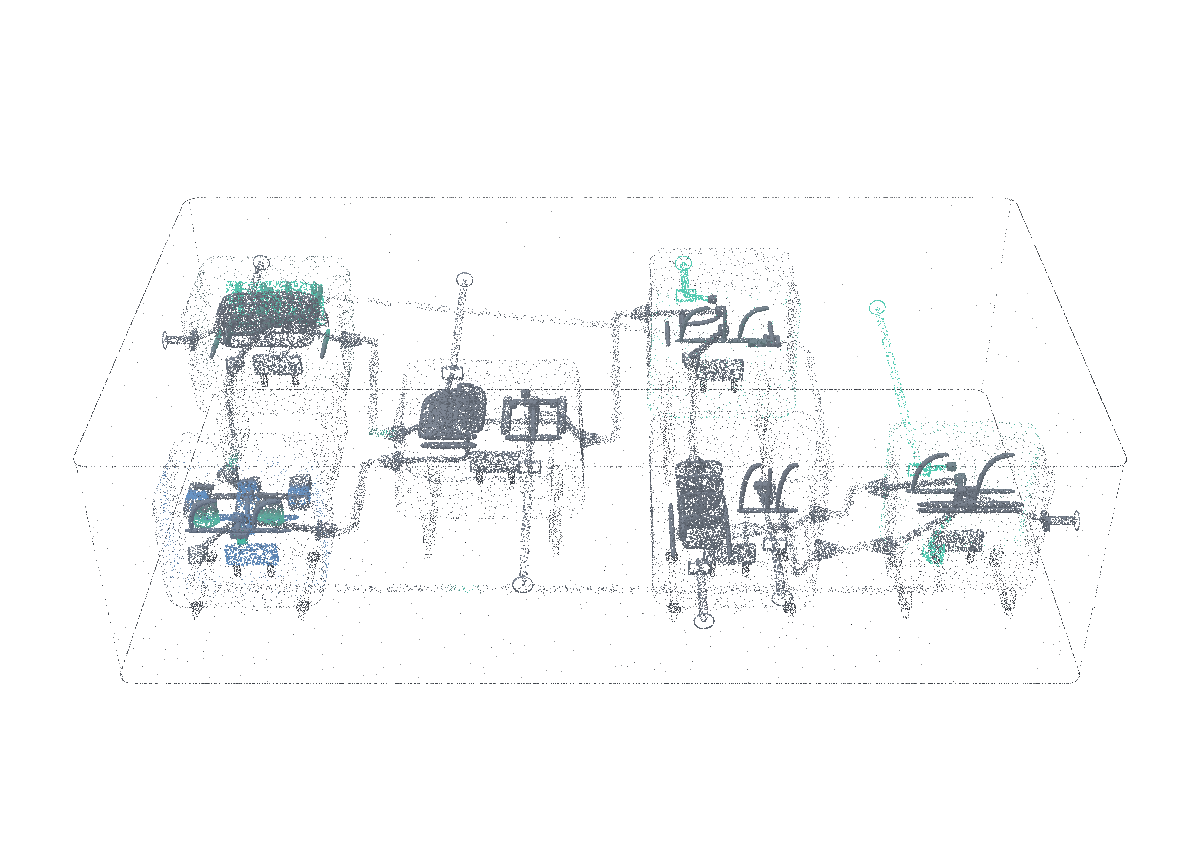
From incomplete histories to an earlier operating decision.
Predictive and preventive systems are forecasts with stated uncertainty for grid and asset operators, so that they act before a peak or a failure and can check the forecast afterward.
Weather services show that learned forecasts can beat physics models on most targets while costing far less to run. Extrasensory applies the same discipline to equipment and load: each forecast states its uncertainty, is stored before the outcome and is scored afterward.
A maintenance date and a failure forecast answer different questions.
Two assets can have the same service interval and different operating histories. A signal can rise because load changed, because condition deteriorated or because the measurement is unreliable. Our predictive architecture keeps those explanations separate before relating them to an intervention.
Reconstruct exposure
Longitudinal histories retain operating exposure, event time, changing conditions and incomplete observations. Surviving assets contribute evidence without being labeled as failures.
Starts with
Asset/context history and event observations.
Produces
An explicit population at risk over time.
Estimate under the current condition
Equipment-class priors provide a cold-start basis. Condition adjustments add local evidence while keeping the inherited assumptions visible.
Starts with
Class information and applicable local observations.
Produces
A survival/risk estimate with its evidence basis.
Carry uncertainty into the decision
The model retains horizon, applicability and uncertainty when comparing inspection, maintenance and continued operation.
Starts with
A forecast plus criticality and available interventions.
Produces
A bounded recommendation whose assumptions remain inspectable.
Return to the observed outcome
Stored forecasts precede later outcomes, preserving the basis for calibration and intervention review.
Starts with
A recorded prediction and subsequent event history.
Produces
An attributable prediction/outcome comparison.
The event history determines what the model is learning.
Extrasensory’s general-purpose architecture carries explicit longitudinal training geometry. The maritime predictive/preventive application is one operating context; domain adapters retain their own equipment and observation rules.
Censoring and delayed entry
A history ending without a failure is not a negative event at every future horizon. An asset first observed part-way through its life enters the risk population at that later time.
Competing and recurrent events
Different events may terminate a period of exposure, while a repaired or repeatedly serviced asset can produce further event intervals. Their labels and risk sets must retain that distinction.
Leakage-aware data geometry
Predictor inputs are separated from future outcome information. Grouped partitions keep evaluation populations and calibration assumptions explicit.
Maintenance and inferred risk
A calendar or hours-based countdown can coexist with a survival estimate. The architecture does not collapse either into the other.
Shift load before the evening peak
The grid operator decides whether and how far to shift load; the forecast supplies the band. Illustrative.
1 of 4Temperature and demand signals arrive for the next evening.
2 of 4The forecast shows demand rising toward line capacity, with a calibrated band around it.
3 of 4A window opens to move flexible load earlier, before the band touches capacity.
4 of 4The grid operator shifts battery charging into the window, and the action and the later outcome are both logged.Decision: The grid operator decides how much load to shift.
Select any part of the drawingScroll to step · Esc to skipFig. 1
1 of 4Two weather inputs disagree, and the forecast band widens.
2 of 4The upper edge of the band reaches capacity, while the central estimate stays below it.
3 of 4The grid operator chooses a smaller step: a standby agreement in place of a full shift.Decision: The grid operator chooses a hedge over a full shift.
4 of 4The outcome is scored against the stored forecast, wide band included.
Select any part of the drawingScroll to step · Esc to skipFig. 1
1 of 4The forecast calls for shifting load, but a maintenance outage limits one feeder.
2 of 4The constraint removes part of the window, and only some actions remain possible.
3 of 4The grid operator chooses the smaller shift the feeder allows.Decision: The grid operator chooses within the constraint.
4 of 4The log records the forecast, the constraint and the chosen action together.
Select any part of the drawingScroll to step · Esc to skipFig. 1
Where it changes the work.
Illustrative situations, connected to the mechanisms that make them possible.
Follow condition on an operating vessel
Marine engineering
Load, condition and sensor histories change while equipment remains in service.
How it works
Exposure-aware diagnostics and time-to-event estimates connect the condition record to risk.
What changes
The engineering team can investigate how operating context changes the evidence behind an assessment.
Start with a sparse failure history
Industrial operators
An asset has limited local failure data but belongs to an understood equipment class.
How it works
Class priors and condition adjustments form an explicit cold-start basis.
What changes
The operator can inspect what the estimate inherits and what the local observations contribute.
Compare the next useful intervention
Asset-intensive organizations
Inspection, continued operation and maintenance carry different practical constraints.
How it works
Criticality and uncertainty inform a bounded comparison of available interventions.
What changes
The decision can retain its assumptions and be revisited when subsequent evidence arrives.
Scroll to explore · Esc to skip
Sparse data still needs an explicit evidence basis.
The system can combine class information with operating observations while showing which part of the estimate comes from each.
Class priors and maturation
A cold start uses an equipment-class basis. Accumulated applicable evidence changes the local estimate and its stated maturity rather than inventing local failure labels.
Multichannel diagnostics
Load normalization and condition channels distinguish an operating regime change from an anomaly. Bounded feedback tuning changes declared parameters within limits.
Grouped conformal calibration
Finite-sample rank-based calibration retains its partition and statistical assumptions. The existence of a conformal method does not create unconditional coverage under arbitrary distribution shift.
Criticality-aware response
The intervention layer compares feasible actions under operational constraints. A high predicted risk does not itself grant actuation authority.
Task outcomes have a different forward model.
Vagus predicts whether a defined episode ends well and how many resources it is likely to consume. Its proxy/0.2 target is an episode completed without an observed interruption or red-test/failure ending; independently labeled outcome_ok is separate. Neither is an automatic measure of task correctness. It does not apply an asset-failure model to a software task.
Hierarchical outcome probability
A Beta–Binomial hierarchy links portfolio, holder, repository, task kind and worker. Sparse cells inherit a bounded prior from related observations without counting the same branch twice.
Input
Task features available before execution.
Output
A declared outcome probability and evidence basis.
Resource distributions
Log-normal models produce token and wall-time medians with 80% intervals in the inspected implementation. These are nominal model intervals; estimates remain distinct from budgets, observed coverage and guarantees.
Prequential scoring
The ledger scores a prediction made before its outcome. Unknown endings stay unlabeled; target definitions and a running-base-rate comparison remain explicit. Brier score, log loss and reliability bins are compared with a running base rate; uncertainty is clustered by root session and subgroup verdicts are Holm-adjusted.
Predictive planning research
Manna’s typed world-model boundary links a forecast to an objective, scope, horizon and expiry before a bounded proposal can be admitted.
Input
A scoped belief and current grant.
Output
A proposal whose motivating forecast can be compared later.
The research organ’s prediction is separate from action authority and installed adoption.
An operator can see what would change the recommendation.
In an illustrative operating episode, a vessel’s condition signal rises during a higher-load period. The explanation follows the operating history, the applicable condition model and the uncertainty around the decision.
The intervention record distinguishes the load-normalized evidence from the maintenance countdown, names the forecast horizon and compares the available response. A later inspection can supply a new observation without rewriting what the system knew when it made the earlier recommendation.
That is the common technology path from prediction to prevention. Data sources, event definitions, calibration population and intervention permissions remain specific to the commissioned domain. The general-purpose edition does not inherit every vessel-specific implementation by naming it.
Specifications and interfaces.
Inputs, retained state, outputs and limits of Naevum’s Predictive & preventive systems architecture.
Longitudinal risk geometry
Operating exposure, censoring, delayed entry, competing events and recurrent intervals are represented with an explicit leakage policy.
Sparse-data prognosis
Condition-adjusted survival modeling combines equipment-class priors with applicable local observations. Maintenance countdown and inferred failure risk remain separate outputs.
Condition diagnostics
Multichannel inputs and load normalization preserve operating-regime context. Parameter feedback is bounded to declared tuning ranges.
Calibration basis
Grouped partitions and finite-sample conformal ranks retain their population, split and statistical assumptions. Coverage claims require matching evaluation evidence.
Intervention constraints
Criticality, uncertainty and feasible operational actions contribute to the recommendation. Prediction does not replace the operator’s authority.
Task-outcome posterior
Vagus uses hierarchical empirical-Bayes Beta–Binomial estimates for a named task target, with fitted and bounded prior strength.
Resource intervals
Log-normal token and wall-time models report medians and 80% intervals in the reference implementation. Prospective coverage is evaluated separately.
Prediction record
Target, input cutoff, horizon, units, scope, applicability and expiry remain distinct from the eventual outcome and from the action grant.
Model transfer scope
Asset, task-resource and simulated-state models retain separate labels and evaluators. Federated/representation-learning research is not presented as an operating general-purpose capability.
Questions about Predictive & preventive systems.
What makes a prediction trustworthy?
Evidence of calibration and usefulness for the specified domain, horizon and decision. Prospective evaluation should include false alarms, missed events and whether the response was useful.
The general predictive service and its maritime application retain explicit capability mappings. Longitudinal labels, leakage policy and calibration population are part of the model definition. Federated and representation-learning research is not an operating capability claim.
Vagus’s episode target may be a completion proxy. Its prequential replay respects time order but does not by itself establish prospective downstream utility or a causal worker ranking.
A numerical interval needs its assumptions
Nominal resource intervals, conformal coverage and survival uncertainty refer to different models and populations. Calibration evidence is specific to the target, horizon and observation process.
For a commissioned domain, the technical contract records data eligibility, event definition, censoring, applicability, prediction record and available interventions. No accuracy, downtime or financial improvement figure is inferred from implementation alone.