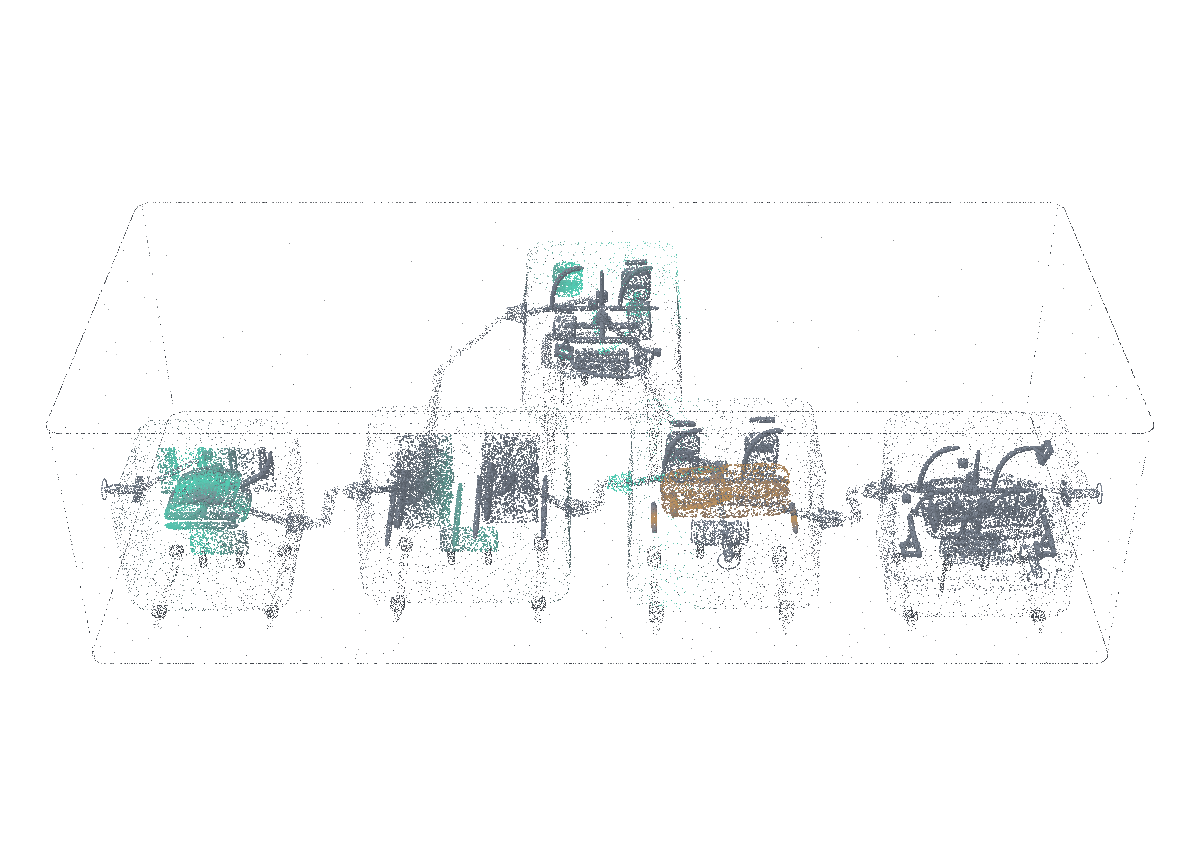
Naevum’s research practice connects mechanisms, experiments and reusable engineering.
Mechanism and hypothesis
Describe the interaction that should cause the proposed effect and the conditions under which it applies.
Experiment and contradiction
Choose a baseline and a test that could show the idea is wrong. Preserve negative findings.
Artifact and contract
Package the result with interfaces, environmental assumptions, evidence and unresolved obligations.
Adoption and later utility
Examine the component in a receiving system. Reuse is valuable when it helps the next task under its actual conditions.
Research questions across the lab.
The lab explores mechanisms whose effects can be examined in a concrete operating setting.
Authority-preserving memory
How can temporal recall retain evidence and uncertainty without promoting observations into instructions?
Observer-aware model work
How can a disclosure decision account for what an observer already knows across several effects?
Evidence-conditioned prediction
How should sparse histories, priors and uncertainty inform a useful intervention?
Provenance-carrying simulation
How can a result retain the method, units and input lineage needed to challenge it?
Where it changes the work.
Illustrative situations, connected to the mechanisms that make them possible.
Find the mechanism before building again
R&D and software teams
A new problem may overlap earlier engineering in another project.
How it works
Typed component and method registers retain contracts, scientific references and lineage.
What changes
The team can inspect a candidate and the evidence behind its reuse.
Challenge an invention early
Research organizations
A plausible idea may reproduce known prior art or fail under a simple counterexample.
How it works
Prior-art search, negative controls and evidence grades stay attached to the technical claim.
What changes
Research effort can move toward a discriminating experiment before the idea becomes a product promise.
Carry knowledge between projects
Institutions
A useful engineering result should survive its original author and project.
How it works
The selected method retains inputs, contract, limitations and its experimental record.
What changes
A later team receives a technical argument it can inspect and reproduce.
Scroll to explore · Esc to skip
Choose the right form for the result.
Research output can become a component, method, publication, invention investigation or a decision to stop.
A documented idea, a tested technical effect, a filed application and a granted patent are different milestones. Rights, disclosure and publication are handled for the particular work.
Learning needs a record of what changed.
Proprietary operating knowledge can support several different improvement paths. The first research decision is which layer needs to change and how its contribution will be tested.
A source-connected memory can change what an existing model receives. Calibration and selection can change a system’s estimates or choices. Updating model weights or an adapter is a separate intervention with its own data and model-access requirements.
Research such as SEAL and Language Models Need Sleep studies model adaptation and consolidation. FunSearch pairs generated candidates with an evaluator. Each engagement selects its update mechanism, evaluation task and operating boundary before work begins.
Preserve the original experience
Keep observations, expert decisions, generated descendants and later outcomes distinguishable. Source access and permission to create training derivatives are separate questions.
Protect the comparison
Compare a fixed baseline, evidence retrieval and any proposed adaptation using held-out work. Generated variants retain ancestry so they cannot silently cross the evaluation boundary.
Measure useful change and retained capability
Score future task utility, earlier accepted behavior, calibration where relevant, data exposure and full cost across repeated updates.
Promote a versioned candidate
Keep the model, data, method and evaluator identities with the result. Accept or retain the incumbent through an explicit decision, with a tested recovery route.
A few useful questions.
Can we commission a feasibility investigation?
Yes. A bounded investigation can establish what is technically plausible, identify the decisive unknowns and deliver an experiment or artifact that supports the next decision.
Technical reference5 mechanisms · 2 further sections
The mechanisms underneath.
The technical choices that give Naevum’s invention practice its particular behavior.
Scientific evidence travels with the method
A mechanism retains its scientific references or the explicit search that found none. Failed searches, counterexamples and refutations remain useful research outcomes.
Components and methods are different registers
One register describes what a system does; another describes how work is performed. Typed identities, contracts and lineage connect candidates without confusing a workflow with executable capability.
Evidence has a promotion ladder
Assertion, available artifact, functional evidence, independent reproduction and replication carry different grades. A negative control tests that the proposed verification can actually fail.
Composition preserves the argument
Candidate discovery, compatibility checks and discriminating experiments connect a question to a reusable result. The reason a component was selected remains available to the next project.
Invention is a technical claim
Mechanism, technical effect, prior art and a deliberate disclosure decision form the invention path. Candidate claims, filed applications and granted rights remain distinct records.
Carry the question all the way into adoption.
Mechanism and hypothesis. Describe the interaction that should cause the proposed effect and the conditions under which it applies.
Experiment and contradiction. Choose a baseline and a test that could show the idea is wrong. Preserve negative findings.
Artifact and contract. Package the result with interfaces, environmental assumptions, evidence and unresolved obligations.
Adoption and later utility. Examine the component in a receiving system. Reuse is valuable when it helps the next task under its actual conditions.
Research questions across the lab.
Authority-preserving memory. How can temporal recall retain evidence and uncertainty without promoting observations into instructions?
Observer-aware model work. How can a disclosure decision account for what an observer already knows across several effects?
Evidence-conditioned prediction. How should sparse histories, priors and uncertainty inform a useful intervention?
Provenance-carrying simulation. How can a result retain the method, units and input lineage needed to challenge it?