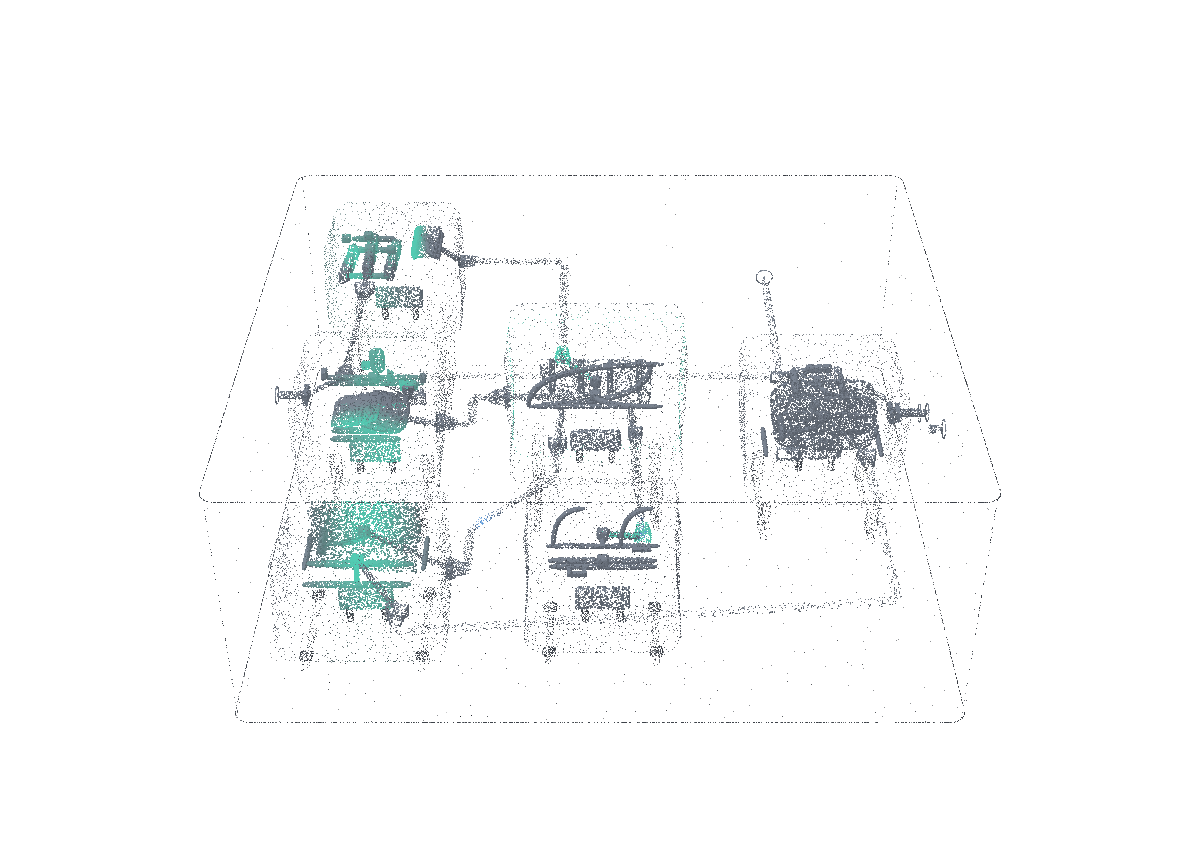
An architecture of specialized intelligence organs.
Bio-inspired design is how Naevum divides memory, attention, prediction and action among separate organs, for research leads, so that the system prepares for demand before it arrives.
Artificial neurons in Intel's Hala Point neuromorphic research system, as Intel reports it
Intel's figures show brain-inspired hardware at research scale, while peer-reviewed results say the gains depend on the workload. Naevum takes the design lesson: separate organs for memory, attention, prediction and action, each tested on its own job.
Intelligence needs an internal organization.
An institution can have abundant documents and capable models yet still lose the reason for a decision, interrupt the wrong person or repeat a failed action. Our architecture combines dedicated organs whose state and exchanges can be inspected.
Hippocampal memory
Vagus indexes claims, episodes, lessons and failures while canonical records retain source, time and authority. Recall can reconstruct an earlier evidence state.
Input
A scoped question and time basis.
Output
A bounded set of evidence-bearing memories or a reason for abstention.
Thalamic attention
A subject-specific leaky potential accumulates trust-weighted evidence. Threshold crossing, refractory state and standing-condition logic decide what deserves examination.
Input
Fresh signals, their provenance and the previous potential.
Output
A new, standing or cleared attention item.
Cerebellar forward models
Hierarchical outcome and resource models predict before work runs. The later result is compared with the stored forecast. The proxy/0.2 target means an episode completed without an observed interruption or red-test/failure ending. Independent outcome_ok labels form a separate target; neither is an automatic measure of task correctness.
Input
Task class, worker and operating context known before execution.
Output
An outcome estimate and resource intervals tied to their evidence.
Basal-ganglia-inspired selection
Eligible workers are compared through posterior sampling with bounded exploration. An estimate can recommend a worker; it does not grant permission to run it.
Input
Eligible alternatives and their outcome posteriors.
Output
A selection recommendation with an explicit evidence basis.
Purpose, resources and boundaries keep the organs coherent.
Manna supplies the continuing organism structure: a sealed constitution, specialized cells, supervised pipelines, resource envelopes and gated effects. Synapse regulates the interaction with outside model computation.
A constitution outside the model
Genome laws constrain the action gate. A model’s proposed step cannot rewrite the laws that decide whether it may act.
Internal condition becomes control input
Interoception and attention retain resource pressure, active obligations, organ freshness and uncertain effects. Their role is coordination under finite capacity.
A selective intelligence boundary
Synapse records admitted source ancestry and cumulative observer exposure before transport. The membrane analogy refers to these software controls.
Controlled development
The organ-lifecycle design allocates only reviewed templates with a finite resource grant and lifetime. Birth, retirement and interrupted allocation have separate records.
A reviewed template and available grant.
An identified organ or a refused allocation.
Manna’s attention, lifecycle and continuity studies are opt-in reference implementations, not active by default. Their integration is qualified for the deployment profile.
Prepare before demand arrives
The research lead sets how far regulation may move resources; the forward model says when. Illustrative.
1 of 4A conference deadline approaches, and past episodes say review requests will rise.
2 of 4The forward model estimates the coming load, and how sure it is, before the load arrives.
3 of 4Regulation moves capacity early, within the limits the research lead set.Decision: The research lead sets how much capacity may move.
4 of 4When the requests arrive, resources are ready and the trace stays inside the band.
Select any part of the drawingScroll to step · Esc to skipFig. 1
1 of 4Demand arrives that no signal predicted.
2 of 4Regulation falls back on feedback, which is slower, and the trace leaves the band for a while.
3 of 4The gap between forecast and outcome is recorded as surprise.
4 of 4The research lead reviews the surprise and decides whether a new signal belongs in the model.Decision: The research lead decides whether to add the signal.
Select any part of the drawingScroll to step · Esc to skipFig. 1
1 of 4Demand falls after the deadline.
2 of 4The forward model expects a quiet period.
3 of 4Regulation proposes releasing capacity and moving maintenance work into the lull.
4 of 4The research lead approves the maintenance plan.Decision: The research lead approves the plan.
Select any part of the drawingScroll to step · Esc to skipFig. 1
Where it changes the work.
Illustrative situations, connected to the mechanisms that make them possible.
Use outside intelligence on a bounded task
Institutions and R&D teams
A useful model needs context, while the organization holds a much larger sensitive source.
How it works
Select a source-bound projection and account for its disclosure to the actual observer before dispatch.
What changes
The organization can inspect the approved context, purpose and destination of the model work.
Specialists working toward one purpose
Engineering teams
Several specialized agents need a shared direction and finite resources.
How it works
Constellations combine bounded mandates with attention allocation and fault isolation.
What changes
A failure or urgent signal can be addressed locally while the broader objective remains intact.
Learn which work succeeds
Operational teams
Different attempts consume different resources and produce different outcomes.
How it works
Outcome predictions and delayed reward joins retain the task and source behind each observation.
What changes
Selection can improve from recorded experience while the operator keeps control of authority.
Scroll to explore · Esc to skip
Attention has dynamics that a priority label cannot express.
The Vagus implementation combines leaky integration with evidence freshness and surprise. An unchanged alarm and a newly deteriorating condition do not contribute in the same way.
Decay and charge
Potential decays with elapsed time. Active drivers add weighted level × trust; a changed fingerprint adds a new charge, while an unchanged condition adds a smaller standing contribution.
Firing and recovery
The potential must cross its threshold outside the refractory interval. The active cause must still support the item, so leftover potential alone cannot create a fresh issue.
Ranking and state remain separate
An uncapped potential informs salience ranking; a capped potential controls firing persistence. A chronic heavy condition therefore remains distinguishable from a lighter one.
Missing evidence is a condition
The freshness model marks stale, missing and errored inputs. The observer losing sight of a problem is different from the problem disappearing.
Prediction, selection and modulation carry different information.
The forward model estimates consequences; selection compares eligible alternatives; modulation changes how quickly the system explores or attends.
Hierarchical empirical Bayes
Outcome estimates use Beta–Binomial updates across portfolio, holder, repository, task and worker contexts. Sparse contexts borrow a bounded prior from related observations. A level’s posterior is Beta(s + k·m, f + k·(1 − m)), where m is the parent mean and k is a fitted, bounded prior strength.
Prequential evaluation
A prediction is scored against an outcome that arrives later. Unknown endings are excluded from the labeled outcome population. Resource medians and intervals remain separate from the outcome probability.
Five modulation signals
Pressure, threat, opportunity, patience and plasticity are bounded state variables. Their gains alter rates and thresholds; the API does not return an actuation verdict.
A changed policy travels through the whole environment.
In an illustrative composed episode, an institutional procedure changes while a long-running review is interrupted.
Temporal memory retains both the earlier instruction and the new rule. Attention notices a genuinely changed source instead of treating every repeated observation as new. The forward model estimates the next episode’s defined outcome, total token use and wall time. A continuing agent retains the objective and unresolved approval. Synapse checks the next external model task against its source and observer history.
This is the ecosystem’s technical argument: specialized state, explicit connections and authority that remains traceable as work continues. Biological inspiration names the design lineage; the implemented algorithm and its deployment profile define the behavior.
Specifications and interfaces.
Inputs, retained state, outputs and limits of Naevum’s Bio-inspired technologies architecture.
Six differentiated functions
Temporal memory, signal integration, forward prediction, eligible-action selection, bounded modulation and constitution-governed execution have separate state and contracts.
Leaky attention reference
The inspected Vagus configuration uses a six-hour half-life, a 24-hour refractory period and a capped firing potential of 4. These are selected reference-implementation parameters, not neuronal measurements.
Trust-weighted signals
Measured evidence charges attention fully, derived evidence at half weight and untrusted evidence at zero. Freshness failures feed an explicit unknown driver.
Standing versus surprise
Fingerprint changes add the full active-driver charge. Unchanged observations add a smaller elapsed-time term, preserving chronic conditions without repeated immediate interruption.
Hierarchical outcome model
Beta–Binomial posteriors estimate a declared outcome target. Prior strength is fitted and bounded; sibling/ancestor evidence avoids counting a branch’s observations twice.
Resource forecast model
Token use and wall time use log-normal models with medians and 80% intervals in the inspected forward-model implementation. Their coverage needs its own evaluation.
Posterior-guided selection
Thompson sampling compares eligible worker posteriors and retains an exploration route. Observational task histories do not establish a causal superiority claim.
Constrained organ lifecycle
Template digest, purpose, parent, resource grant, lifetime and outstanding obligations remain attached to an organ. Retirement preserves unresolved effects and protected functions.
Engineering scope
These are computational mechanisms and selected architecture, with module-specific activation and qualification. They do not assert consciousness, biological equivalence or neuromorphic hardware.
Questions about Bio-inspired technologies.
Why use biological ideas?
Living systems offer useful design questions about specialized functions, regulation and continuity. The engineering value depends on the explicit algorithm and its measured effect in software.
Integrate-and-fire models describe integration and threshold events. Vagus applies a software-specific attention rule with source trust, freshness, surprise and standing-condition state.
Hippocampal, cerebellar and basal-ganglia names identify design inspiration. The claim algebra, Bayesian model and sampling rule specify the actual computation; these are not claims of biological equivalence or consciousness.
One environment, several evidence contracts
Memory returns provenance-bearing records. Attention produces items. Prediction estimates a named outcome. Selection recommends among eligible alternatives. Manna’s gate and Synapse’s admission control consequential effects.
The opt-in Manna developmental and continuity studies have separate activation and evaluation. The presence of source code is different from an installed end-to-end capability or measured benefit.