Software that regulates its own operating conditions.
Adaptive control is how Naevum's software paces itself under load, for operations managers, so that due work and approvals hold while the system slows the rest.
Load arrives unevenly; regulation should look ahead
Capacity often sits idle, disruptions still arrive every month, and physiology suggests the efficient response is to prepare early. Naevum's controllers slow ordinary work under load while due work and approvals keep their place, so an operations manager can see which work was protected and why.
A busy system must preserve the work that matters.
New requests arrive while a worker is late, memory is constrained and a verification step is due. A fixed-rate loop keeps spending; a simple priority queue can neglect recovery. Our control architecture keeps observations, commitments and permitted responses separate.
Measure the operating condition
Manna’s interoception reads load, available memory and thermal limits. Unknown observations remain explicitly marked; a missing sensor is not a healthy reading.
Starts with
Timestamped resource observations.
Produces
Bounded pressure plus the terms and unknowns behind it.
Allocate attention to obligations
The attention allocator retains each obligation’s identity, owner, remaining need, deadline and protected status. Due protected work receives service before ordinary claims.
Starts with
Open obligations and fresh organ heartbeats.
Produces
An allocation within a finite per-tick and per-organ budget.
Adjust within an envelope
Rate changes, scheduling and resource allocation remain within declared bounds. Pressure can tighten behavior while the action gate retains authority.
Starts with
Condition estimates and the current mandate.
Produces
A bounded change followed by another observation.
Condition
A controller cannot lower an approval requirement or expand a capability.
Several control laws solve different parts of the problem.
Naevum uses bounded feedback and stateful selection rather than one opaque “health score”. The result retains enough internal state to explain why behavior changed.
Physiological pacing
The reference interoception design takes the maximum of known load, memory and thermal pressure terms. Above its selected pressure threshold, it stretches the tick interval by a bounded multiplier.
Input
Normalized known pressure terms.
Output
A pace multiplier and an evidence record.
The reference configuration stretches by at most 4×; this is a design parameter, not a throughput promise.
Dwell and fairness
The allocator gives the current focus a dwell bonus and applies a rolling per-organ cap to ordinary work. A noisy specialist cannot purchase the entire shared attention budget.
Input
Urgency, slack, capped salience and recent allocations.
Output
Service assignments with protected-work exceptions.
Setpoint regulation
Vagus’s vital-sign regulator keeps two integral states, updates them from measured condition and reference, and applies a paired cancellation step before producing a clamped PI output.
Input
A measured condition, reference and previous regulator state.
Output
A bounded velocity recommendation.
An unmeasured interval does not advance the regulator; this discrete software law carries no imported biological stability guarantee.
Get through a month-end load spike
The operations manager sets the pace range and the protected work; the controller acts inside it. Illustrative.
1 of 4The operations manager sets the pace range and marks the month-end close as protected work.Decision: The operations manager sets the range and the protected work.
2 of 4At month end, measured load rises above the usual range.
3 of 4The controller slows ordinary work and shifts attention to due obligations, inside the manager's range.
4 of 4The close completes, and ordinary work moves back toward its usual pace.
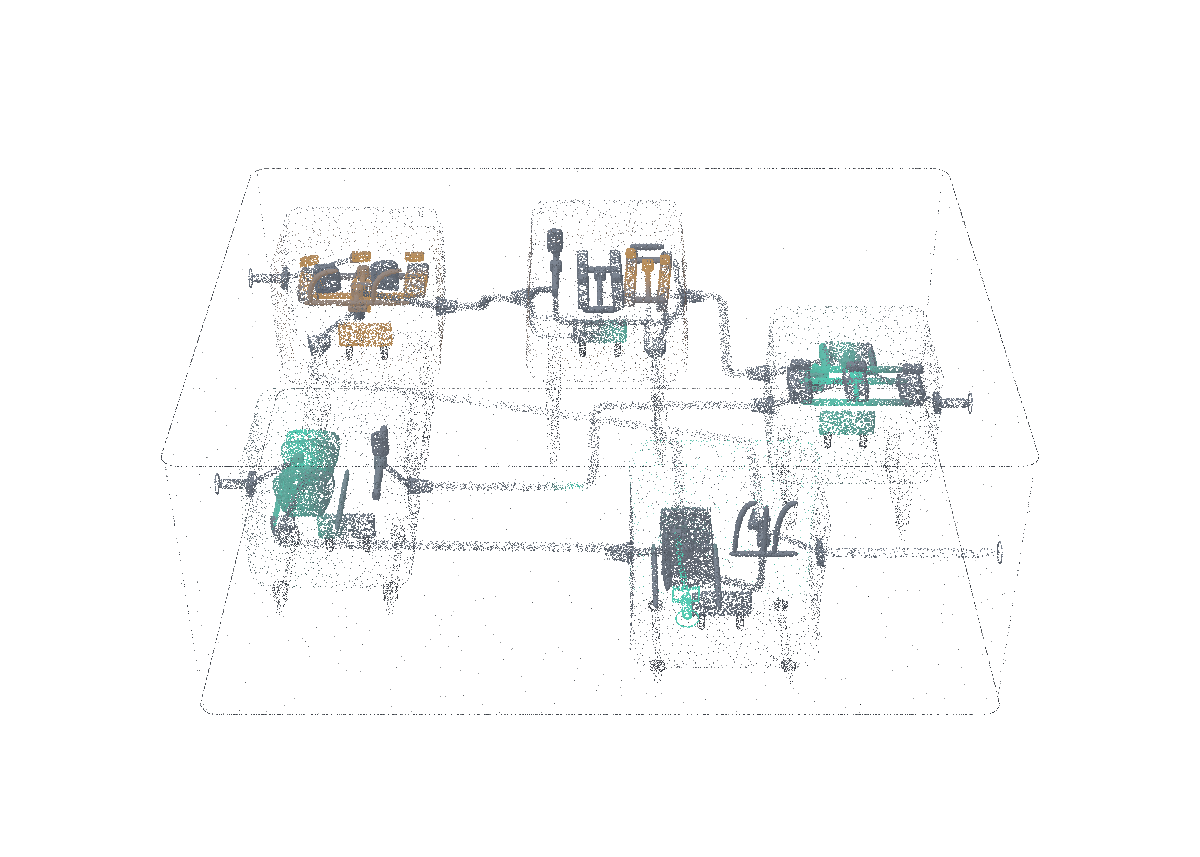
Select any part of the drawingScroll to step · Esc to skipFig. 1
1 of 4Load stays high after the close, as audit requests begin.
2 of 4The controller holds the slower pace and caps each task's share, so one busy task cannot take all the attention.
3 of 4Work that slips is listed with its owner and deadline, so the manager sees exactly what is late.
4 of 4The manager decides which late item gets extra capacity; the controller has no power to relax an approval to go faster.Decision: The operations manager reassigns capacity.
Select any part of the drawingScroll to step · Esc to skipFig. 1
1 of 4Measured load falls back inside the band.
2 of 4The controller relaxes the pace in steps, so the system does not swing back and forth.
3 of 4Deferred work returns to the queue in order of due date.
4 of 4The manager reviews what slowed, when and why, and decides whether to change the range.Decision: The operations manager decides whether to change the range.
Select any part of the drawingScroll to step · Esc to skipFig. 1
Where it changes the work.
Illustrative situations, connected to the mechanisms that make them possible.
Follow condition on an operating vessel
Marine engineering
Load, condition and sensor histories change while equipment remains in service.
How it works
Exposure-aware diagnostics and time-to-event estimates connect the condition record to risk.
What changes
The engineering team can investigate how operating context changes the evidence behind an assessment.
A process with a safe stopping point
Industrial edition
An operational process must react to observations while respecting equipment and responsibility boundaries.
How it works
A pipeline separates perception, proposal and gated action; the journal records the resulting state.
What changes
Operators can inspect why a step was admitted, stop the process and recover from its record.
Attention across a technical estate
Engineering organizations
Signals arrive from many projects, workers and resource windows.
How it works
Temporal attention integrates repeated observations and uses failure and outcome memory.
What changes
The operator sees why a matter deserves attention without treating every new observation as an emergency.
Scroll to explore · Esc to skip
A persistent condition and a new event need different responses.
Vagus maintains a potential for each subject. New evidence adds a full weighted charge; repeated unchanged evidence contributes a smaller standing term. Decay, firing and recovery are explicit state transitions.
Accumulation and trust
Charge is weighted by condition and evidence trust. Measured signals contribute fully, derived signals contribute at reduced weight and untrusted signals do not charge the attention potential.
Threshold and refractory state
Crossing the attention threshold can produce an item. A refractory period prevents repeated immediate firing while the ongoing condition remains visible as standing.
Blindness and resolution
A stale sensor cannot silently clear the condition it used to observe. The system retains the standing issue with stale evidence until its own cause is measured resolved.
The same architecture preserves different responsibilities.
The control laws serve a declared operation; they do not decide what the organization is allowed to do.
A research workload
A resource-constrained personal agent slows ordinary work while retaining its objective and pending approvals. A recovery obligation remains identifiable.
Context
Resource observations and due work.
Experience
A bounded schedule without discarding commitments.
An institutional estate
Vagus combines repeated engineering signals, changing attention and historical failure evidence. An operator sees why an issue remains active or has become unobservable.
Context
Freshness-aware project and infrastructure observations.
Experience
A prioritized attention record with its basis.
An industrial process
The architecture separates equipment observations, a proposed response and the permitted actuation path. Physical interfaces and safety limits are specific to the commissioned installation.
Context
Process condition and the operator’s mandate.
Experience
A recorded proposal and admitted effect.
Specifications and interfaces.
Inputs, retained state, outputs and limits of Naevum’s Controllers & adaptive control architecture.
Interoceptive record
Load, available memory and thermal observations remain alongside pressure, its component terms and explicit unknown status. Pressure is bounded to [0, 1].
Reference pacing law
The inspected design begins stretching at pressure 0.6 and bounds the multiplier to [1, 4]. Deployment tuning is part of the operating profile.
Obligation state
Each obligation carries identity, organ, remaining attention need, deadline, weight, protected status and served count. Lost-organ detection retains its open obligations.
Attention allocation
Protected due work is allocated first; ordinary work follows urgency and slack, capped salience, dwell and a rolling per-organ share. Failed outcomes damp ordinary claims.
Antithetic-inspired PI state
Two integral accumulators update from observation and reference; their paired cancellation feeds proportional/integral terms and a bounded output. The recommendation does not set a verdict.
Temporal attention states
New, standing and cleared conditions are distinct. Decay and refractory timing retain history between observations; stale evidence remains distinguishable from resolution.
Bounded modulation
Pressure, threat, opportunity, patience and plasticity affect exploration, attention threshold and maintenance rates through clamped gains. Permissions are outside that rate API.
Deployment contract
The inspected Manna interoception and attention modules are opt-in reference implementations, not active by default. Control modules and operating integrations have separate activation profiles. Sensor basis, parameter ranges, intervention conditions and recovery are fixed for the commissioned system.
Questions about Controllers & adaptive control.
Does adaptation mean rewriting the system’s permissions?
No. A controller changes behavior within its operating envelope. A change to authority needs its own authorized process.
The two-integrator Vagus regulator is antithetic-inspired, with a discrete proportional/integral output. Briat, Gupta and Khammash establish a biological control motif under their mathematical assumptions. Those results do not transfer automatically to a software deployment.
The Manna reference pacing and attention implementations use explicit parameter bounds and preserve unknown measurements. Their activation and tuning belong to the named operating profile.
The integration defines the plant
A software work queue, a model-serving workload and an equipment process have different observations, response delays and effectors. The controller contract identifies those objects, the response range and the intervention path.
Rate recommendations remain separate from approvals and verdicts. A stale interval cannot be treated as a fresh observation of a healthy plant.