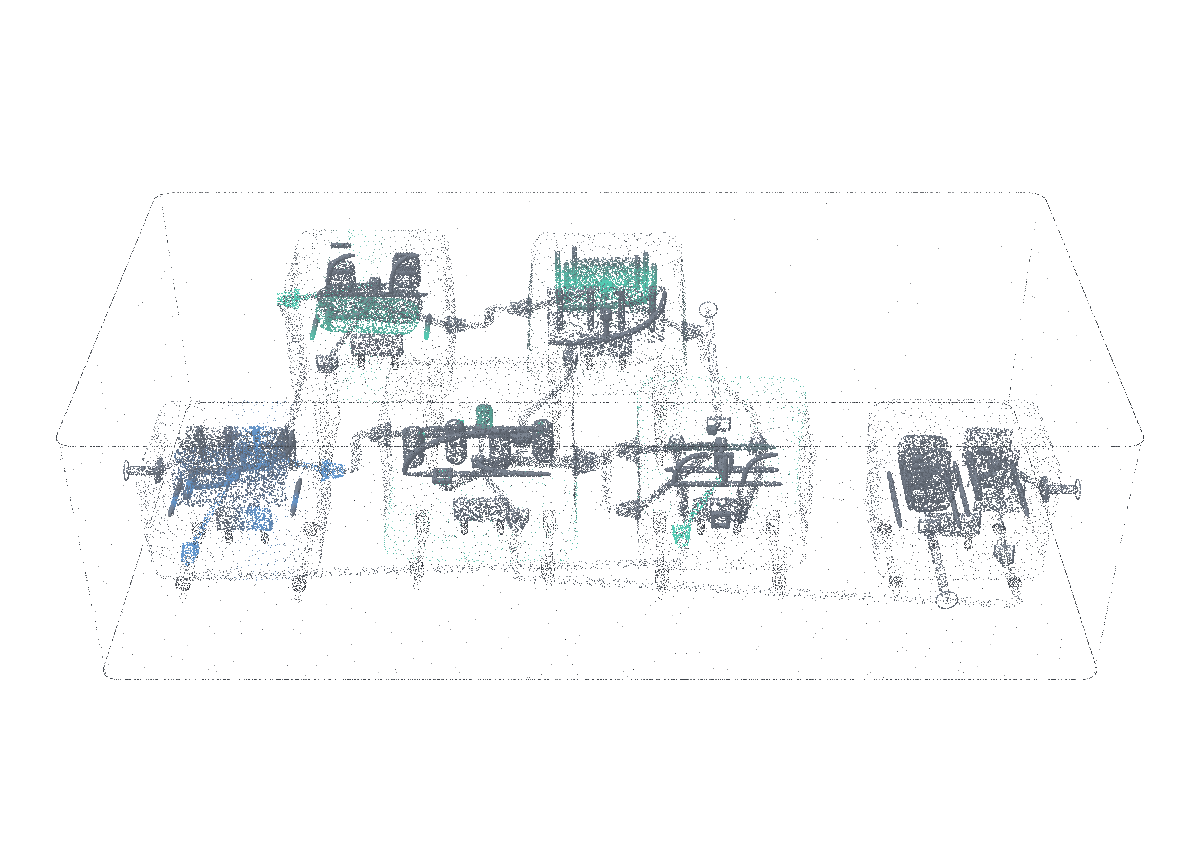
Naevum's software development method is a protected core, a replaceable harness and contract-carrying components for VPs of engineering, so that a prototype becomes a system another team can operate.
The yearly fall in the price of a fixed level of model performance, by benchmark.
Reaching a given model capability now costs a small fraction of what it did, yet MIT NANDA's preliminary findings say few custom enterprise tools reach production. The cost has moved from the model to the system around it, so Naevum builds that system first: a protected core, a replaceable harness and components that carry their contracts.
A prototype is only one part of the system.
A model can answer correctly while its application loses approvals, repeats a tool action or fails when another team takes over. Our development architecture carries the same objective through planning, implementation, independent challenge and the exact delivered artifact.
Black Box defines the delivery responsibilities. Agency Engine supplies application controls and product seams. Conductr separates the coding harness into replaceable components. The Vault checks the assumptions carried by reusable engineering. Together they give a custom system an architecture for how it is built as well as how it runs.
Mandate and acceptance
The factory design begins with an owner-confirmed scope, permitted effects, budget and expiry. An independently authored acceptance condition precedes implementation.
Starts with
A defined user journey and operating context.
Produces
A bounded work package with its acceptance basis.
Condition
The planner proposes work; confirmation belongs to the responsible owner.
Separate implementation and challenge
Coder, reviewer and QA responsibilities are separated. Findings refer to the source they examined, so a correction changes what must be checked.
Starts with
One work package and exact source revision.
Produces
A candidate, findings and source-bound checks.
Condition
A successful attempt does not authorize its own release.
Durable continuation
A handover packet retains decisions, findings and the next unresolved obligation when an attempt ends.
Starts with
The attempt’s artifacts and observed results.
Produces
A record from which a successor can continue.
Condition
Uncertain effects and failed acceptance remain visible.
A new product keeps its own experience and inherits a protected core.
Agency Engine separates the kernel, service kit, UI hooks, component kit and screens from the product-owned shell. Imports point towards the foundation; product-specific composition sits above it.
Sealed governance services
Gate and decision logic, the ledger, write boundary, capabilities, evidence, approvals, model admission and connector/store custody form the sealed set. The architecture declares these services non-replaceable. A closed-list startup guard and contract tests check the declared bindings; this is not process isolation or protection against arbitrary new bindings.
Input
Product composition and requested capabilities.
Output
An application whose permitted extensions have explicit boundaries.
Five configuration layers
Engine defaults, product configuration, installation, organization and workspace or seat merge in that order. A lower layer may tighten inherited policy.
Input
Versioned defaults plus local context.
Output
The effective policy for that installation.
A local preference cannot grant a capability denied by an earlier layer.
Service and release contracts
Services declare whether they belong in the client or a separately operated cell. Versioned packages and per-layer software bills of materials define a release independently from a product’s appearance.
Input
Selected service contracts and package versions.
Output
A product dependency graph and upgrade boundary.
The client/cell tag describes the boundary; actual placement belongs to the deployment profile.
Durable semantic work
Agency’s semantic orchestration design separates task/output contracts from individual attempts. A typed dependency graph drives readiness; journal replay reconstructs work state without another reasoning call. An uncertain effect blocks automatic reissue.
Input
A versioned intent graph, prior events and declared output contract.
Output
Reconstructed task state, eligible work and retained unresolved effects.
Exactly-once external consequences require matching support at the effect sink.
Take a prototype to a system another team can run
The VP of engineering accepts the system; a reviewer who did not build it runs the tests. Illustrative.
1 of 5A prototype works once, in a demo, with its approvals written into a prompt.
2 of 5The protected core takes over approvals, records and model access, and the prototype keeps its screens.
3 of 5The harness that runs the model becomes a slot with a contract, so engineers can change it without touching the core.
4 of 5Reused components bring their assumptions, and the team turns each open one into a test.
5 of 5The VP of engineering accepts the system once a reviewer who did not build it passes those tests.Decision: The VP of engineering accepts the system.
Select any part of the drawingScroll to step · Esc to skipFig. 2
1 of 4A cheaper open model matches the current one on the team's own benchmark.
2 of 4The team swaps it into the harness slot, and the core and its approvals stay as they were.
3 of 4The same acceptance tests run against the new model on the team's real tasks.
4 of 4The VP of engineering approves the switch after the tests pass.Decision: The VP of engineering approves the model switch.
Select any part of the drawingScroll to step · Esc to skipFig. 2
1 of 4A second product needs the same document-review component.
2 of 4The component's contract lists an assumption about file size that the new product breaks.
3 of 4The team turns that assumption into a test, and fixes the component before reuse.
4 of 4The VP of engineering approves reuse with the test attached to the component.Decision: The VP of engineering approves the reuse.
Select any part of the drawingScroll to step · Esc to skipFig. 2
Where it changes the work.
Illustrative situations, connected to the mechanisms that make them possible.
Turn architectural direction into delivery
Organizations commissioning custom AI
A difficult brief spans data, software, interfaces and operating responsibilities.
How it works
The Planner defines a mandate; implementation, review and QA preserve its acceptance conditions.
What changes
The customer can examine how the delivered system answers the original brief.
Continue after a worker disappears
Engineering teams
A development attempt ends before the work is resolved.
How it works
The source-bound handover retains objective, checks, findings and the next decision.
What changes
Another attempt can continue from the durable record rather than relying on a departed session.
Launch another product from the same core
Product organizations
A new application needs its own workflow, language and interface.
How it works
Compose a product-owned shell and selected services above the sealed governance core.
What changes
The team can change the experience without rebuilding approvals, evidence and custody controls.
Scroll to explore · Esc to skip
Compatibility includes the assumptions between components.
The Vault’s composition checker carries assumptions as data. Matching a function signature does not establish that two components agree about timing, order or who owns a resource.
Pipe and parallel
Typed ports connect sequential or concurrent components. Request/offer checks compare cadence, ordering and whether a value may be absent.
Context
Producer guarantees and consumer requirements.
Experience
Connections plus compatibility findings.
Feedback and wrap
Feedback closes a declared loop; a wrapper adapts a component’s environment. Assumptions that neither a neighbor nor the environment satisfies remain obligations of the composition.
Context
Component contracts and the proposed arrangement.
Experience
A composed contract with unresolved obligations retained.
Scope
An uncomparable event rate remains unknown; it does not become a compatibility pass.
The harness has parts that can be tested separately.
Conductr defines a context engine, planner, orchestrator, executor, sandbox, router, verifier, policy gate and event store as interface-bounded slots. The orchestrator coordinates their order; a component can be replaced without pretending its responsibilities disappeared.
Externally defined acceptance
A work node names files, the intended change, forbidden changes and an acceptance test. The executor works against that external oracle.
Input
A manifest node and seeded repository.
Output
An edit and its acceptance result.
Assurance outside the live loop
Verifier findings and trust events are observed separately from the agent’s ongoing context. A policy gate may act at the commit boundary.
Input
The candidate diff and declared promises.
Output
Findings, policy decisions and event records.
Conductr’s degrading integration seams are distinct from Synapse’s disclosure-admission controls.
Controlled harness experiments
The proving-ground manifest fixes task battery, model, context strategy, repetitions and seed basis for baseline and treatment. Gated metrics and tracked metrics have separate roles.
Input
Two harness configurations on the same task basis.
Output
A comparison tied to its tasks, variation and acceptance rule.
A measured harness improvement is specific to that experiment.
One approval workflow, from request to recovery.
In an illustrative composed workflow, an institution commissions document review with a restricted appendix and two approval roles.
The application composition defines the two roles and protects the model door. Synapse supplies the context-admission boundary. A work package names the permitted document view, expected review artifact and interrupted-request recovery. Independent acceptance follows the candidate’s exact source, while the handover retains unresolved findings and the operating procedure.
This is how the technology enters a custom engagement: a concrete workflow assembled from explicit controls and individually understood dependencies. The factory triad is the selected delivery design; its automated execution is qualified separately for each project.
Specifications and interfaces.
Inputs, retained state, outputs and limits of Naevum’s Software development architecture.
Mandate record
Scope, ceiling, resource budget, expiry and confirmed plan revision bind a factory work package. A proposed plan is separate from effective authority.
Independent acceptance identity
The acceptance condition, candidate revision, findings and artifact hashes travel together. A source change requires checks against the new candidate.
Five application packages
Kernel, services, UI hooks, UI kit and screens sit below a product-owned frontend/backend shell. The declared sealed-set bindings are checked at startup and in contract tests; this closed-list guard is not process isolation.
Monotone policy composition
Engine → product → installation → organization → workspace/seat. Later policy can narrow the permitted set; it cannot widen it.
Four-operator contract algebra
Pipe, parallel, feedback and wrap operate over typed ports and assume–guarantee contracts. Unresolved assumptions propagate outward.
Request/offer compatibility
Port checks include cadence, ordering and absence tolerance. A slower producer fails a faster consumer’s declared requirement; uncomparable rates stay unknown.
Harness experiment manifest
Baseline and treatment pin model, context strategy, loop, task battery, repetitions and seed basis. Statistical gates are declared separately from tracked diagnostics.
Versioned distribution
Semantic package versions, dependency boundaries and software bills of materials keep component changes attributable to an application release.
Questions about Software development.
What does Naevum contribute beyond an agent writing code?
The contribution is the surrounding architecture: protected application controls, contract-aware reuse, independent acceptance, replaceable execution components and durable delivery records. These mechanisms connect a business workflow to an inspectable system.
Which parts are shared and which are custom?
The application foundation supplies shared governance and selected services. Domain logic, interfaces, integrations, local policy and acceptance conditions belong to the engagement. Factory automation and deployment boundaries are qualified for the named project.
The Vault’s assume–guarantee checker carries unfulfilled assumptions outward. Its request/offer checks cover cadence, absence and ordering. That addresses architectural mismatch beyond matching data types.
The Black Box triad is the selected factory design. Agency package seams, Conductr’s component assembly and Vault composition have their own contracts and implementation evidence. Automated factory acceptance remains project-specific.
A custom engagement binds its source, deployed configuration, acceptance conditions and operating evidence. No generated code count or general harness benchmark replaces that contract.