Simulation & living worlds

A changed input should have a coherent consequence.

Simulation & worlds is Naevum’s work on rule-based models for planners and world builders, so that every change in a simulated site or world traces back to its rules.

  • Simulation
  • Digital twins
  • Living world
Discuss a simulation or living world
Physical scenarios and event-driven world changes. Two illustrative methods retain separate physical calculations and completed world consequences.
Loading model
Technical descriptionsInteractive model unavailable. The static illustration and descriptions remain available.
State and assumptions
Retain the selected domain state, source basis and current identity.
Technical data

Inputs

Explicit physical assumptions or world state; distinct selected views.

Explicit next scenario basis or actual settled world state.

Transformation

Retain the selected domain state, source basis and current identity.

Retained state and outputs

Site/device units, input quality and baseline.

World/reign identity and current authoritative state.

Constraints

Physical configuration and living-world state are separate scenario domains.

Controlled change and input
Introduce one explicit physical alternative or a separately chosen world decision.
Technical data

Inputs

Tagged physical change or royal decision, never merged signals.

Transformation

Introduce one explicit physical alternative or a separately chosen world decision.

Retained state and outputs

Original baseline and changed assumption.

Royal choice and candidate generation identity.

Constraints

The selected alternative retains the original baseline or world decision identity.

Domain rule and transition workbench
Use different internal operations for physical calculations and world contributions.
Technical data

Inputs

Unchanged baseline or authoritative world rules.

One explicit domain-appropriate change.

Transformation

Use different internal operations for physical calculations and world contributions.

Retained state and outputs

Electrical/thermal/inference checks and hourly storage balance.

Validated campaign, bounded repair or authored fallback and role tasks.

Constraints

Physical calculations and world-task rules do not share a fictitious universal solver.

Constraint and settlement comparator
Keep calculated feasibility distinct from admitted durable world change.
Technical data

Inputs

Physical feasibility and time-basis results for the physical view.

Actual completion under the proposed task identity.

Identified proposed task and permitted consequences, not completion.

Transformation

Keep calculated feasibility distinct from admitted durable world change.

Retained state and outputs

Memory fit, physical limits, state of charge and shortfall.

Actual independent completion under authoritative world rules.

Constraints

Calculated feasibility and an actually settled world consequence are different results.

Scenario and history register
Retain comparisons and actual accepted consequences.
Technical data

Inputs

Physical comparison or actually settled world consequence.

Transformation

Retain comparisons and actual accepted consequences.

Retained state and outputs

Coherent baseline/alternative cases and unresolved constraints.

Settled events precede story and next-world context.

Constraints

Generated prose cannot replace an independent completion or a settled world record.

Two illustrative methods retain separate physical calculations and completed world consequences.

Additional mechanisms are described in the technical reference.

What the research says

Simulated worlds are becoming public infrastructure.

25 agents1
Generated characters in a research town spread one invitation and coordinated a party
83%2
Interview-based agents matched people’s survey answers, relative to their own retest
Over €300M3
EU funding for the first phase of Destination Earth, a digital twin of the planet

Researchers now build simulated people, and the EU funds a simulated planet. A simulation earns trust when each result traces back to its rules and inputs. Builder and Everbloom show every result together with the rules that produced it.

A layout and a living world both carry state.

A denser rack changes memory capacity, power and cooling. A royal choice changes the work available to a kingdom. A scene is useful when those consequences follow the model’s rules rather than a visual effect.

A physical design model

Builder’s device → rack → room → building → plot hierarchy ties geometry to declared equipment and site assumptions. A layout change propagates into feasibility and operating calculations.

Context
Placed equipment, workload and tagged assumptions.
Experience
Traceable design-point and hourly scenarios.

A persistent social world

Everbloom connects a reign and day to generated events, role-specific tasks, settlement and the Chronicle. The accepted state becomes part of later play.

Context
Royal choices, permitted world context and player contributions.
Experience
Coherent tasks and durable world history.

Builder follows a number back to its assumptions.

Each calculated value names a method and its inputs. Tagged inputs carry a value, unit, source/assumption status and optional low/high bounds. Changing a scenario reruns the connected calculation graph.

Spatial feasibility

Containment, overlap, aisle clearance, rack mass, floor load and site footprint relate the placed objects to physical constraints. Checks distinguish a sourced limit from a recorded design assumption.

Three power bases

Installed nameplate supports breaker and fit checks. Provisioned peak sizes the load. Utilization-based average power supports energy estimates. Those three values remain distinct.

Power and thermal propagation

The electrical tree adds conversion/distribution losses. Air/liquid heat splits, airflow, coolant flow and cooling power propagate into the facility demand.

Uncertainty through recomputation

Base, low and high scenarios rerun coherent sets of tagged inputs. The result retains limiting assumptions and source quality instead of adding an unexplained percentage to the final answer.

Can we test a rule in a world before the world?

Two copies of one world run side by side, one with the rule; a person compares them and decides. Illustrative.

  1. 1 of 4A mid-sized city’s policy team proposes a rule: lower speed limits on residential streets.
  2. 2 of 4Two copies of the same simulated city run side by side, one with the rule and one without.
  3. 3 of 4Simulated residents respond in each copy, following the same assumptions in both.
  4. 4 of 4The policy maker compares the outcomes on identical inputs and decides what happens to the rule.Decision: Adopt, revise or drop the rule.
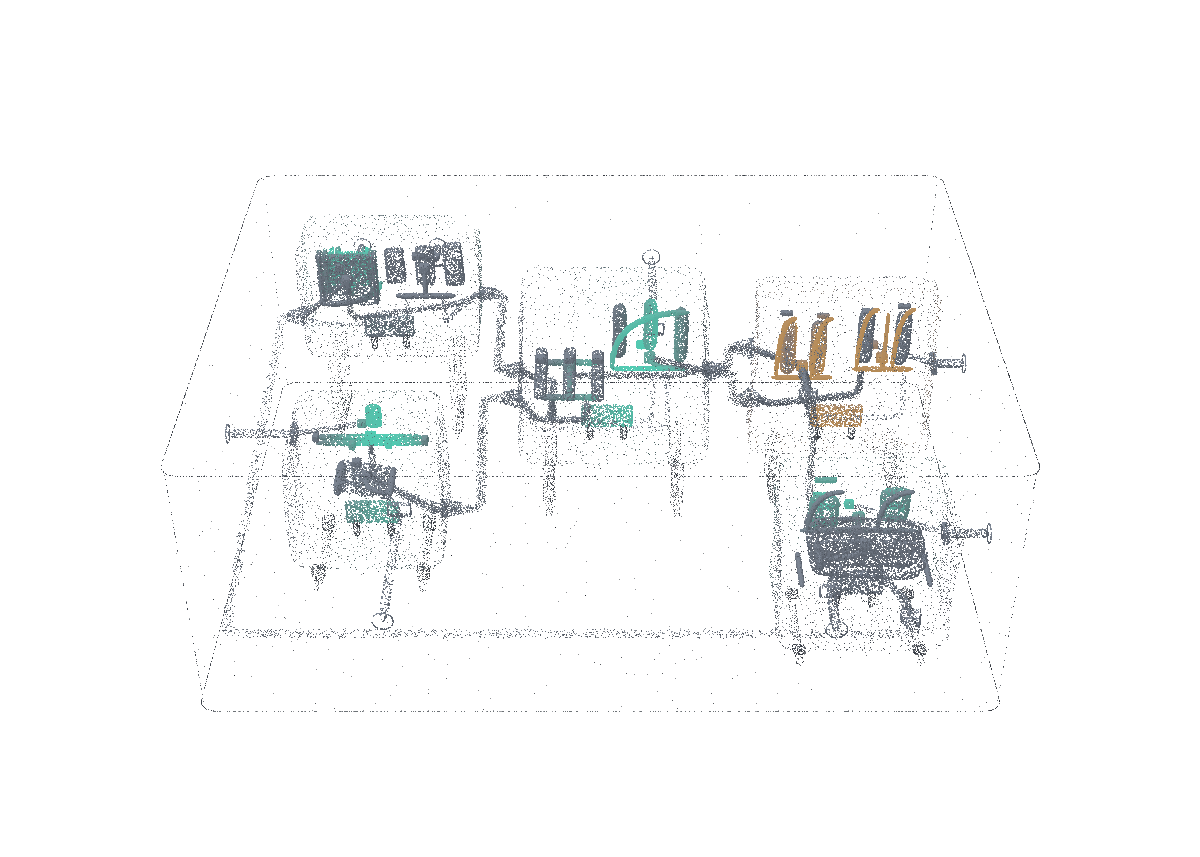
Select any part of the drawingScroll to step · Esc to skipFig. 1
  1. 1 of 4A facility owner proposes a rule: no rack may draw more than its row’s cooling allows.
  2. 2 of 4Builder runs the site twice on the same workload: the current layout and one that follows the rule.
  3. 3 of 4Power, cooling and inference capacity are recomputed for both, each figure with its assumptions.
  4. 4 of 4The owner sees what the rule costs in capacity and decides whether to adopt it.Decision: Adopt, revise or drop the cap.
Select any part of the drawingScroll to step · Esc to skipFig. 1
  1. 1 of 4A world designer proposes a rule: the market closes while a festival runs.
  2. 2 of 4Two test copies of the kingdom play the same reign, one with the rule.
  3. 3 of 4Role tasks change in one copy and not the other, while the treasury rules hold in both.
  4. 4 of 4The designer compares the two Chronicles and decides whether the rule reaches players.Decision: Ship, revise or drop the rule.
Select any part of the drawingScroll to step · Esc to skipFig. 1

Where it changes the work.

Illustrative situations, connected to the mechanisms that make them possible.

Rule a kingdom together

Players

A King chooses a response to a threat while a Queen shapes the kingdom’s cultural life.

How it works
Their decisions branch into tasks for court roles and clubs, with shared consequences.
What changes
One decision becomes an activity people can undertake together in a changing place.

Leave something in the world’s history

Players and world creators

A successful reign should remain meaningful after its rulers change.

How it works
The Chronicle connects actual contributions and decisions to persistent world records.
What changes
Participation can become a recognizable part of the kingdom’s continuing story.

Compare an energy and investment scenario

Operators and investment planners

A denser design changes electrical demand, heat, annual energy and cost assumptions.

How it works
Power and thermal propagation share a scenario basis with annual weather, supply and storage.
What changes
The decision retains units, input quality and sensitivity instead of presenting one unexplained ROI figure.

Inference capacity reaches all the way to the site.

A model’s weights are only one memory demand. Context length, concurrency and the device’s memory/compute limits change what a configuration can actually serve.

KV cache and concurrency

KV bytes per token = 2 × layers × KV heads × head dimension × bytes per element. Context length and concurrent sequences multiply that demand. Remaining accelerator memory bounds the feasible batch.

Input

Model shape, precision, context and available memory.

Output

Memory placement and concurrency bounds.

Roofline decode bounds

The decode step uses the slower of the memory-transfer and compute times. Batch sweeps retain the limiting regime and distinguish theoretical roofs from utilization-adjusted estimates.

Facility energy per token

Design-point facility power divided by estimated site throughput produces joules per generated token for that scenario. A memory-infeasible configuration cannot be made feasible by an attractive energy figure.

Hourly energy balance

Generation, grid exchange, battery charge/discharge, export, curtailment and unmet load share one hourly balance. Battery state of charge retains capacity, power and efficiency bounds.

Input

Load and generation series plus storage/grid assumptions.

Output

Annual energy quantities and a traceable shortfall record.

Calculated scenarios are distinct from commissioned hardware measurements.

Everbloom separates generated variation from authoritative state.

A King or Queen’s decision can become a campaign and shared work. Generative content enters through a bounded shape; server-side rules retain identity, settlement and economic consequences.

  1. Generate a bounded campaign

    The generation path ties the request to reign/day context and uses a defined input shape. Generated event content is converted into task structure.

    Starts with
    The permitted campaign context.
    Produces
    A candidate event and role-linked tasks.
  2. Validate and settle identity

    Schema checks and bounded repair precede acceptance. An accepted generated result uses first-writer persistence; refusal can select an authored fallback.

  3. Run the consequence cascade

    The cascade runner separates decision logic from effects. Role-specific work can change world state without making generated prose the authority over the economy.

  4. Retain settlement and history

    Task payouts are idempotent; treasury conservation and durable Chronicle records retain what happened. Player contribution becomes part of the world’s continuing history.

The model exposes its basis as well as its result.

Builder reports source assumptions and method lineage. Everbloom retains the accepted world identity and settlement history. Manna’s planning research uses a bounded synthetic environment with explicit observation and action contracts.

These models serve different decisions. Physical planning explains why a configuration fits or fails and how a workload changes the site. A living world explains how a choice becomes coherent shared activity. Predictive-organ research examines future states before proposing an action.

A custom simulation engagement selects the state, transitions, inputs and outcomes relevant to its real setting. The existing technology supplies a starting architecture with identifiable rules; the relationship to physical measurements or observed player outcomes is evaluated for that application.

Specifications and interfaces.

Inputs, retained state, outputs and limits of Naevum’s Simulation & living worlds architecture.

Spatial model hierarchy
Device, rack, room, building and plot have containment and placement relationships. Geometry checks include overlap, aisles, mass, floor load and land-use assumptions.
Provenance-carrying values
A numeric input retains value, unit, source/assumption tag, source identity and low/high basis. Derived values retain method and input lineage.
Distinct power semantics
Installed nameplate, provisioned peak and utilization-based average power serve different checks. Electrical losses and cooling load propagate to facility demand.
KV-memory equation
Per-token KV bytes = 2 × layers × KV heads × head dimension × bytes per element. Full-context concurrency is bounded by remaining accelerator memory.
Inference roofline
Decode time is bounded by memory transfer and compute across a batch sweep. Throughput, latency limits and joules/token retain the selected utilization and facility assumptions.
Hourly supply/storage model
Load, generation, imports, exports, battery charge/discharge, curtailment and shortfall are balanced at each time step. State of charge respects power, capacity and efficiency.
Scenario uncertainty
Coherent base/low/high input cases rerun the model. Input quality and limiting assumptions remain attached to the result.
Validated world generation
A reign/day-bound request passes structured output checks and bounded repair. Accepted-result persistence and authored fallback preserve a coherent generation identity.
Server-authoritative settlement
Role cascades separate decisions from effects. Idempotent payouts, treasury conservation and Chronicle history retain persistent consequences.

Questions about Simulation & living worlds.

Can the same approach support training or planning?

Yes, when the engagement defines the world’s rules, user decisions, outcome measures and the relationship between simulated behavior and the real setting.

Simulation & living worlds in the stack.

Works with

Physical planning

Coupled configuration and workload scenarios.

Works with

Participatory world

Roles, generation and persistent consequences.

Research connection

Bounded simulation

A controlled environment for scheduling research.

Technical reference2 further sections

The method registry belongs to the result

Builder’s numeric results retain input lineage, units, source status, method identifiers and scenario hashes. Design-point facility power and annual energy balance answer different questions.

KV-memory and roofline calculations establish scenario bounds. Hardware benchmarks, facility commissioning and physical measurements are separate evidence.

Generated content enters through a constrained seam

Everbloom validates structure independently from provider output formatting. Its server assigns identity; frozen phase inputs support deterministic repeated derivation; durable settlement remains outside rerunnable decision logic.

A coherent campaign and idempotent payout are engineering properties. Player enjoyment, retention and observed social outcomes require their own evidence.

Which rule would you test in a world before applying it to yours?

Discuss a simulation or living world