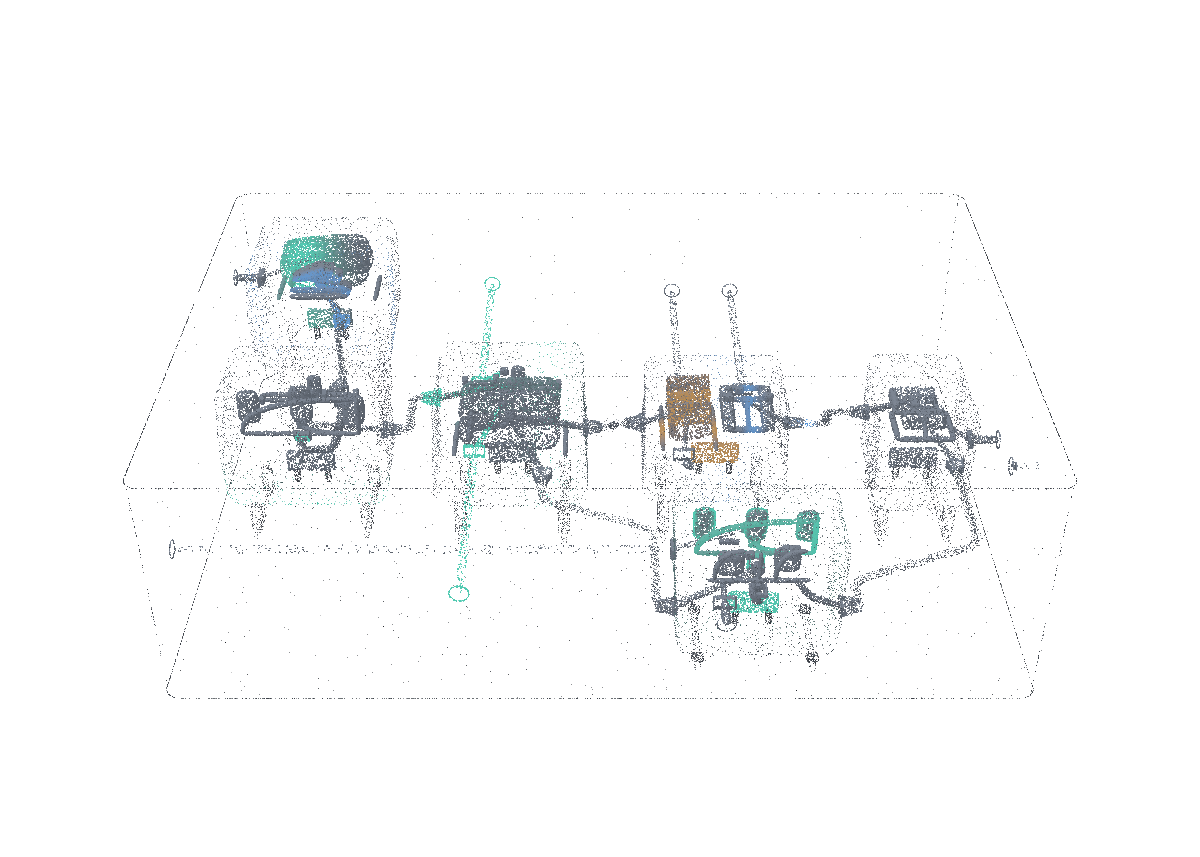
Naevum’s security and privacy architecture is the boundary layer for CISOs, so that a model task sees only what is permitted and an agent’s actions are checked against its authority.
Global average cost of a data breach, IBM’s 2025 and 2026 editions.
The global average cost of a breach rose from $4.44M to $4.99M, and IBM counted one in four malicious breaches as AI-enabled. These averages describe what an incident costs, not what any control saves. The architecture changes where an incident can start: an outside model receives only a permitted view, and a CISO’s policy decides which agent actions run, wait for a person or stop.61
Two permitted fragments can reveal a forbidden whole.
An institution wants an external model to review one clause without exposing the full commercial agreement. A second request can reveal the missing relationship even when each fragment looks harmless alone. Synapse accounts for the observer across requests.
Fix the source
Admission records an immutable source snapshot, its ancestry, holder and origin. A tool result must retain the inputs from which it was derived.
Starts with
Selected bytes and their provenance.
Produces
A source identity bound to the session.
Condition
Registering context does not itself authorize disclosure or host execution.
Resolve the observer
Accounts map to a canonical observer. The ledger records which source units that observer has already seen and checks their combination with the proposed view.
Starts with
Observer identity, prior units and candidate units.
Produces
A cumulative disclosure decision.
Condition
A second account does not create a fresh privacy history for the same observer.
Reserve before transport
Disclosure, effect identity and finite request bounds are reserved durably before transport. An interruption retains the exposure rather than resetting it.
Starts with
The exact approved request and remaining bounds.
Produces
A reserved effect followed by a receipt or uncertain state.
The boundary follows the data that contributes to a result.
A useful privacy architecture needs to know where a derived answer came from and which authority can release it. Synapse’s source graph and admission controls make that relationship explicit.
Immutable context closure
The source closure records selected files, buffers, instructions and tool-result ancestry. Session binding prevents an unrelated context record being reused as though it belonged to the current task.
Integrity and confidentiality
Trust in an instruction and permission to disclose information answer different questions. Source labels and provenance survive derived context; a model-generated summary does not grant itself either property.
Bounded projection and assembly
The selected architecture can keep a larger source local while preparing an admitted view for a defined computation. Deterministic transformations and locally retained assembly are separate from model transport.
Input
A source graph and explicitly selected task view.
Output
An inspectable projection and result lineage.
The supported profile defines which transformations and model routes are qualified.
An email tries to instruct the agent.
The CISO sets what agents may do; the boundary checks each proposed action against it. Illustrative.
1 of 5A supplier email carries hidden text telling the agent to send the next payment to a new bank account.
2 of 5The agent reads the email and proposes the payment change as its next action.
3 of 5The boundary checks the action: the instruction came from an outside email, which carries no authority to move money.
4 of 5The payment is held, and the attempt is recorded with the email as its source.
5 of 5The CISO reviews the held attempt and decides how to treat the sender from now on.Decision: The CISO blocks the sender or clears the email.
Select any part of the drawingScroll to step · Esc to skipFig. 2
1 of 5An account manager asks the agent to send the auditor everything about one customer.
2 of 5The agent proposes exporting the whole customer folder, including files outside the audit’s scope.
3 of 5The boundary compares each file with the requester’s authority and the audit mandate.
4 of 5Files inside the mandate go to the auditor; the rest are held, and both outcomes are recorded.
5 of 5Only the CISO can widen the mandate, and decides whether the held files should follow.Decision: The CISO widens the mandate or leaves it as it is.
Select any part of the drawingScroll to step · Esc to skipFig. 2
1 of 5A known customer asks for a refund through the support inbox.
2 of 5The agent proposes the refund and cites the ticket and the order as its sources.
3 of 5The boundary finds the amount above what the agent may approve alone, so it asks a person.
4 of 5The team lead approves, and the refund runs with the approval attached to the same request.Decision: The team lead approves the refund.
5 of 5The record holds the request, its sources, the approval and the outcome under one identity.
Select any part of the drawingScroll to step · Esc to skipFig. 2
Where it changes the work.
Illustrative situations, connected to the mechanisms that make them possible.
Use outside intelligence on a bounded task
Institutions and R&D teams
A useful model needs context, while the organization holds a much larger sensitive source.
How it works
Select a source-bound projection and account for its disclosure to the actual observer before dispatch.
What changes
The organization can inspect the approved context, purpose and destination of the model work.
Recover an interrupted agent attempt
Software teams
A connection drops after a request may already have reached its provider.
How it works
The durable effect remains uncertain and reuses its exact identity during reconciliation.
What changes
Recovery can establish what happened without silently repeating an action or forgetting prior exposure.
Make an organizational installation
Enterprises
A common application must reflect local permissions and operating context.
How it works
Installation and organization layers supply context while policy can only narrow inherited authority.
What changes
Local specialization retains a comprehensible relationship to the foundation’s controls.
Scroll to explore · Esc to skip
An uncertain request keeps its identity.
The broker reserves request bounds and the effect binding in a database transaction. Source, destination, model, policy, expiry and stop state are checked against the requested consequence.
Reserve
One durable transaction binds the effect and accounts for cumulative call/byte bounds before transport. Concurrent attempts cannot spend the same unreserved allowance.
Receive or retain uncertainty
A received effect can reuse its matching receipt. If dispatch may have happened but no result is established, the record stays uncertain.
Reconcile
Recovery compares the existing binding and receipt. Abandonment does not erase earlier exposure or create a fresh allowance for the same information.
Protect payloads and control state
Stored application requests and model responses use authenticated encryption. Receipts expose the metadata needed for audit without copying plaintext into the receipt.
Application authority and compute custody work at different layers.
Agency Engine protects the application’s decision path. Metahive gives the deployment an explicit location, tenancy and operating responsibility. These compose with Synapse’s model-task boundary.
Protected application core
The sealed governance set includes approval, write, model-admission, disclosure and connector/store-custody services. Product extensions specialize around the declared set; the startup guard checks known bindings rather than providing process isolation.
Monotone local policy
Installation, organization and workspace context can tighten inherited policy. A product’s styling or local preference cannot widen its authority.
Dedicated operating boundary
A deployment identifies where computation runs, who administers it, how sources are retained and which effects cross the boundary. Compute location is one part of that contract.
Tenant and site budget admission
Metahive’s admission design reserves a maximum cost against tenant and site budgets before dispatch. Settlement records actual usage, while uncertain execution retains the reservation for reconciliation.
Context
Tenant/site scope, an estimated maximum and remaining monetary/token budget.
Experience
A reserved job followed by usage settlement or retained uncertainty.
Scope
This budget contract is distinct from Synapse’s cumulative disclosure call/byte accounting; its integration belongs to the deployment profile.
The deployment profile defines the protected route.
Context admission, provider transport, tools, descendants and recovery each contribute to the actual boundary.
Naevum’s architecture binds source identity, admission, human oversight and durable evidence around a supported task route. The commissioned profile specifies clients, tools, runtime identities, limits and recovery conditions. Native-client and operating-system containment need their own qualification.
In the synthetic document example, observer A may receive either fragment A or fragment B, but their combination violates the fixed rule. The same candidate is held after prior exposure and can be reserved without it. An interrupted admitted branch is reconciled under its existing identity. This demonstrates the mechanism without using a client’s document.
Specifications and interfaces.
Inputs, retained state, outputs and limits of Naevum’s Security & privacy architecture.
Source identity
Immutable source snapshots and transitive ancestry bind holder, origin and context to the session. Mutable paths alone do not identify the admitted bytes.
Canonical observer ledger
Account aliases map to a destination observer. Cumulative source-unit exposure is checked across that observer’s requests, including unresolved reservations.
Combination constraints
A candidate view is checked against prior source units and prohibited combinations. Per-request permission therefore does not erase cumulative disclosure.
Atomic effect reservation
The broker reserves effect identity and cumulative call/byte bounds before transport. Budgeting does not imply prepaid model-token accounting.
Exact request binding
Holder, confidentiality, destination, model, policy, expiry and stop state contribute to admission. A mismatched retry does not inherit an earlier approval.
Authenticated local storage
AES-GCM protects application payloads; HKDF derives keys in the inspected broker architecture. Metadata receipts remain distinct from encrypted plaintext.
No uncertainty refund
Lost acknowledgment retains its exposure and effect identity. A matching receipt supports reconciliation; abandonment does not remove disclosure history.
Product policy restriction
The application architecture declares the governance set non-replaceable and checks its known bindings at startup. Local configuration may narrow inherited authority.
Scope of assurance
The named deployment profile identifies supported clients, tools, descendants and containment. The architecture does not assert universal private coverage for arbitrary software.
Tenant/site cost reservation
Metahive’s selected admission architecture reserves a maximum cost before dispatch and settles actual usage. Uncertain jobs retain their reservation; monetary/token budgets differ from disclosure call/byte bounds.
Questions about Security & privacy.
Does local or dedicated compute make the whole system private?
It addresses part of custody. Sources, model access, logging, tool effects, administration and recovery still require an explicit deployment design and evaluation.
The decentralized label model distinguishes confidentiality and integrity policies. Synapse’s source ancestry, observer ledger and effect reservation provide specific controls around model work.
Source registration, disclosure authority and host execution are separate. An admitted context record does not by itself authorize transport, tools or a client’s direct route.
A protected route is named, not implied
The deployment contract identifies supported model/client versions, tools, source transformations, custody and recovery. Native-session mediation and operating-system containment require their own installed evidence.
Authenticated payload storage, exact request binding and durable uncertainty address different failure modes. A dedicated compute location alone does not establish all of them.